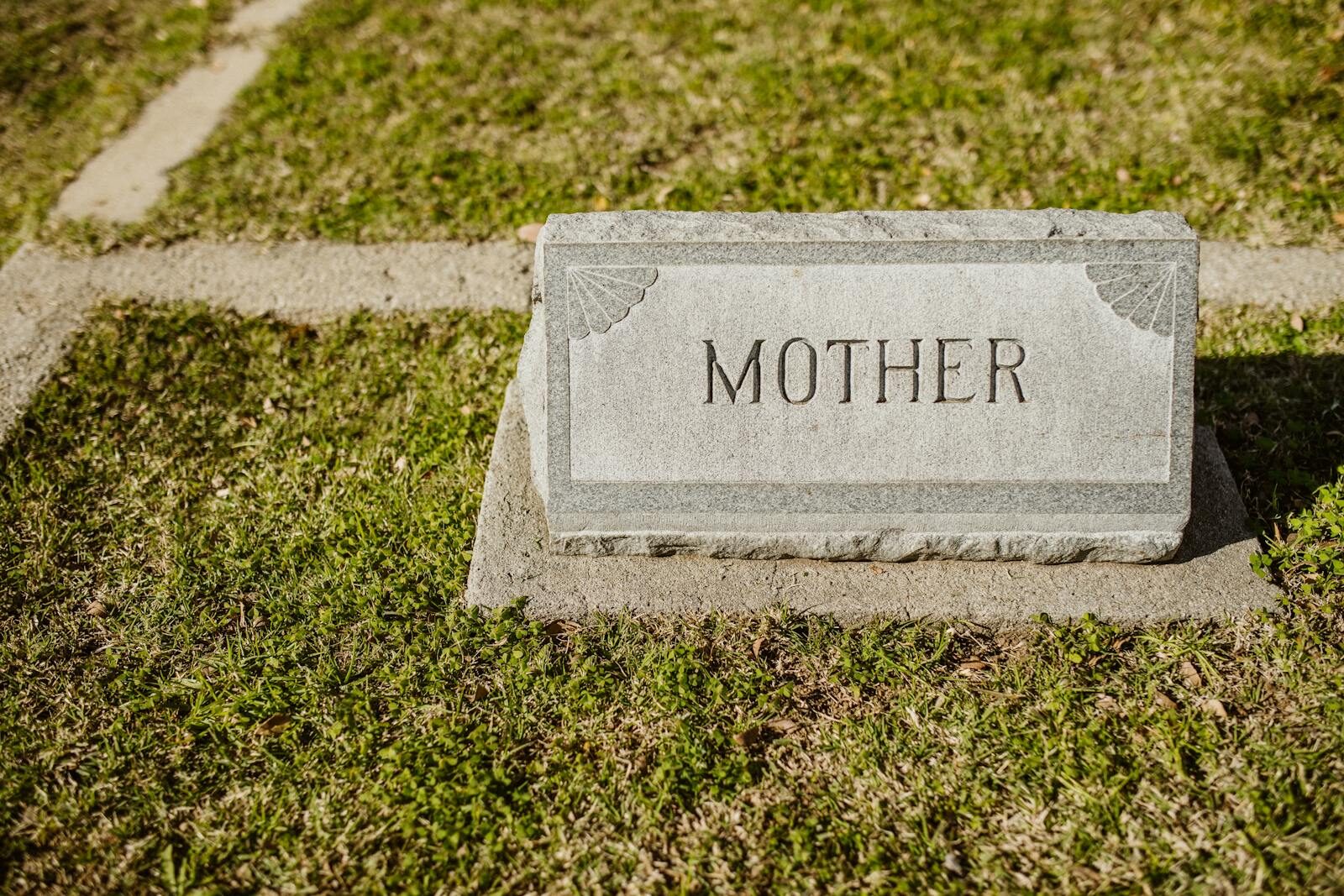
Cemeteries are far more than mere resting places for the departed; they are vast, open-air museums that chronicle human history, changing cultural attitudes toward death, and the enduring power of love and remembrance. As you walk through the quiet pathways of a historic graveyard, you are surrounded by a silent, stone-carved language.
Before the widespread literacy of the modern age, and before the advent of digital obituaries, people relied heavily on visual symbolism to convey the life story, the beliefs, and the sorrow of those who had passed on. The engravings on a headstone—ranging from delicate blooming flowers to imposing crosses, animals, and architectural ruins—serve as a poignant vocabulary of grief, hope, and faith.
Understanding the symbolism in headstone engravings allows us to read these monuments like the pages of a book. It offers a profound glimpse into the values of past generations and the universal human desire to immortalize our loved ones. This comprehensive guide will delve deep into the rich world of funerary art, exploring the intricate meanings behind the most common, and some of the most obscure, symbols found on gravestones around the world.
The Evolution of Funerary Art and Symbolism
To truly appreciate headstone symbolism, one must first understand its historical evolution. In early colonial America, for example, attitudes toward death were stark and often terrifying, heavily influenced by strict Puritan beliefs. The engravings of the seventeenth and early eighteenth centuries were dominated by the “Memento Mori” motif—a Latin phrase meaning “Remember that you must die.”
Headstones from this era frequently featured grim reapers, scythes, hourglasses, and the iconic winged death’s head (a skull with wings). These symbols were not meant to comfort the living, but rather to serve as a harsh warning about the brevity of life and the inevitability of divine judgment.
However, as society transitioned into the late eighteenth and nineteenth centuries, a cultural shift occurred. The harshness of the Puritan outlook softened into a more romanticized, sentimental view of death and the afterlife. This era saw the rise of the “rural cemetery movement,” where graveyards were designed as beautiful, park-like landscapes meant to be visited and enjoyed by families.
Consequently, the grim skulls were replaced by winged cherubs, which eventually gave way to the classic urn and willow tree motifs. By the Victorian era, the language of symbolism had exploded into a highly complex and deeply sentimental vocabulary. Families carefully selected specific flowers, religious icons, and allegorical figures to represent the exact nature of their grief and the precise virtues of the deceased.
The Botanical Realm: Flowers, Trees, and Foliage
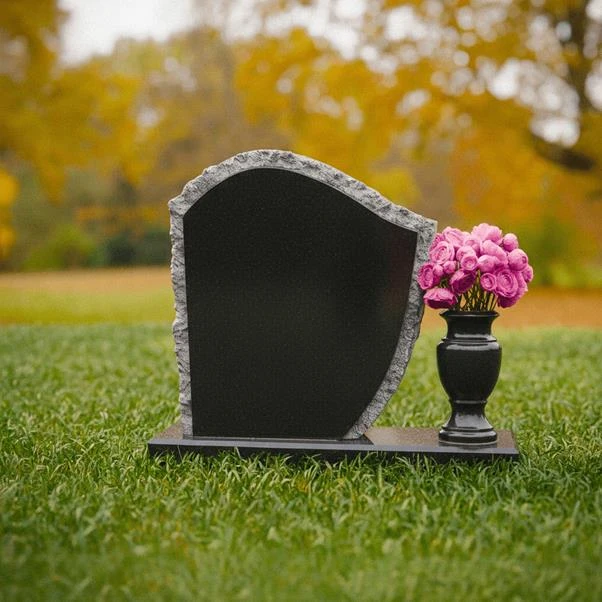
During the Victorian era, the “Language of Flowers” (Floriography) was a cultural phenomenon. People used specific blossoms to communicate complex emotions that social etiquette often prevented them from speaking aloud. This obsession with botanical symbolism naturally transferred to funerary art, making flora one of the most common categories of headstone engraving.
The Rose
The rose is arguably the most universal symbol of love, beauty, and grace. However, in the context of a cemetery, its meaning is heavily dependent on how it is depicted. A rose can represent deep, passionate love, or it can symbolize the transient nature of physical beauty.
The Lily
With its elegant, trumpet-like shape, the lily is fundamentally associated with purity, innocence, and chastity. In Christian symbolism, the Easter Lily represents the resurrection of Christ and the promise of eternal life, making it a popular choice for deeply religious individuals. The Lily of the Valley, characterized by its tiny, bell-shaped blooms, signifies a return to happiness, humility, and the tears of the Virgin Mary.
The Weeping Willow
Perhaps the most iconic symbol of the late eighteenth and early nineteenth centuries, the weeping willow tree is the ultimate emblem of nature’s lament. Its drooping branches visually mimic the posture of a sorrowful mourner, and its association with water ties it to themes of tears and the underworld. Yet, because the willow tree can easily regenerate from a single cut branch, it also stands as a powerful symbol of immortality and life after death.
Ivy and Ferns
Vines and foliage carry their own quiet meanings. Ivy, which clings stubbornly to whatever it grows upon, symbolizes undying affection, fidelity, and the eternal memory of the deceased. It is a promise from the living that the departed will never be forgotten. Ferns, which thrive in the hidden, shaded parts of the forest, represent sincerity, humility, and frankness.
Oak Leaves and Acorns
The oak tree is universally recognized for its massive size, deep roots, and incredibly hard wood. Therefore, oak leaves and acorns carved into a headstone represent strength, endurance, steadfast faith, and a long life well-lived. These symbols are frequently found on the graves of military veterans, community leaders, and individuals who reached an advanced, venerable age.
Decoding the Lifecycle of a Carved Flower
The specific stage of a flower’s bloom on a gravestone was carefully chosen to reflect the age and the life stage of the person buried beneath it.
- The Unopened Bud: Represents a life that has barely begun. This heartbreaking symbol is almost exclusively found on the graves of infants and very young children, signifying innocence and a life taken before it could blossom.
- The Partial Bloom: A flower just beginning to open its petals typically symbolizes a teenager or a young adult who died in the springtime of their life, full of unfulfilled potential.
- The Full Bloom: Represents a person who died in the prime of their life, having fully matured and experienced the world.
- The Severed or Broken Stem: A striking and tragic symbol indicating a life that was abruptly and prematurely cut short, often due to an accident or sudden illness.
- Two Intertwined Flowers: Often found on the graves of married couples or siblings, symbolizing an unbreakable bond that persists even in death.
The Anchor of Faith: Crosses and Religious Iconography
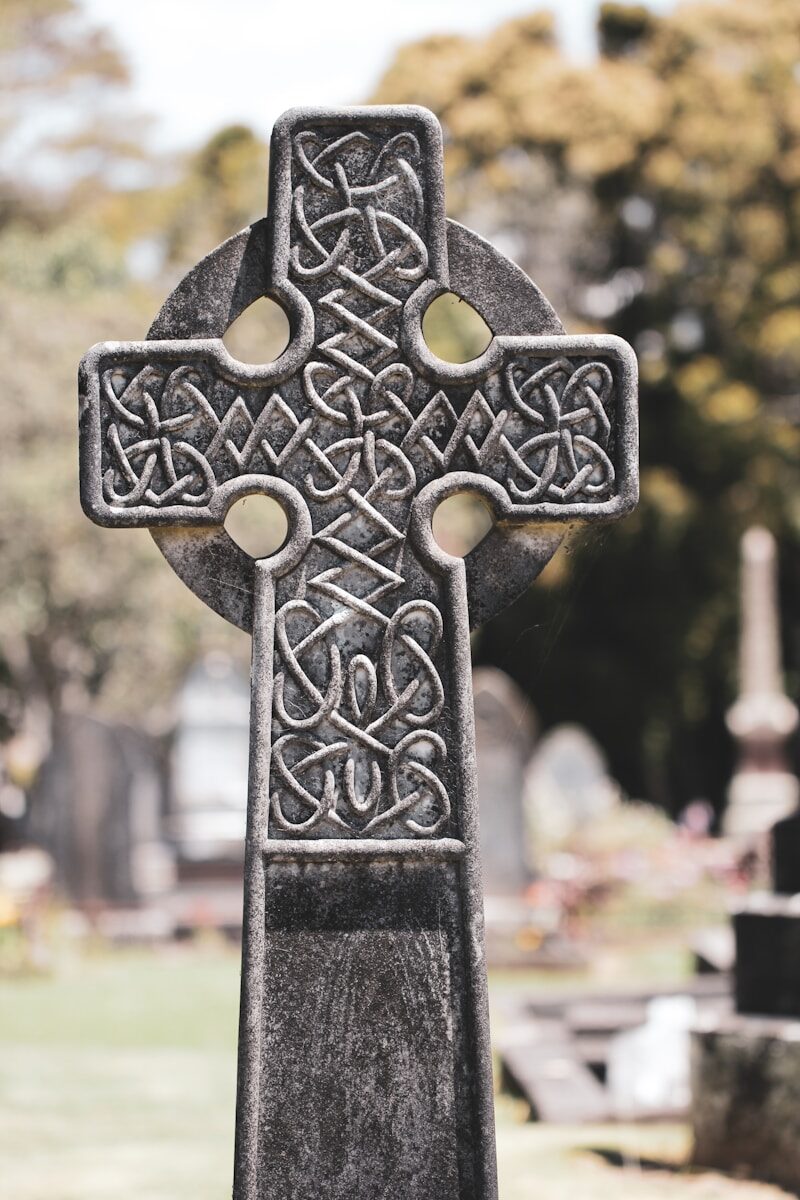
Religious symbols are the bedrock of headstone engravings, serving as permanent declarations of the deceased’s faith and their hope for salvation. The cross, in its many myriad forms, is the most prominent of these symbols. It is not merely a marker of Christianity, but a deeply nuanced icon that tells a specific theological story depending on its design.
| Name of the Cross | Visual Description | Meaning and Historical Association |
| The Latin Cross | A simple cross with a long vertical descending arm and a shorter horizontal intersecting arm. | The most universally recognized symbol of Christianity, representing the crucifixion of Jesus Christ, ultimate sacrifice, and the hope of resurrection. |
| The Celtic Cross | A cross featuring a distinct ring or circle connecting the four arms, often covered in intricate knotwork. | Originating in Ireland and Britain, the circle represents eternity, the sun, and the infinite nature of God’s love. The endless knots symbolize the eternal journey of the soul. |
| The Eastern Orthodox Cross | Features three horizontal crossbeams; the top for the inscription, the middle for the hands, and a slanted bottom beam for the feet. | Primarily used by Eastern European and Russian Orthodox Christians. The slanted footrest symbolizes the two thieves crucified alongside Christ, pointing upward to heaven and downward to hell. |
| The Calvary Cross | A standard Latin cross mounted atop three descending steps. | The three steps represent the hill of Calvary, but also symbolize the three fundamental theological virtues: Faith, Hope, and Charity (Love). |
| The Bottony Cross | A cross where the end of each arm terminates in a cluster of three rounded knobs or “buttons.” | The three knobs on each arm serve as a symbol of the Holy Trinity (the Father, the Son, and the Holy Spirit). |
Beyond the cross, other religious symbols abound. The Star of David (a hexagram) is the universal symbol of Judaism and Jewish identity, representing divine protection. The Menorah, a seven-branched candelabrum, is also common on Jewish graves, symbolizing spiritual illumination and the eternal presence of God.
Angels and Cherubs are also ubiquitous in cemetery landscapes. Angels are viewed as messengers of God, guardians of the soul, and guides who escort the deceased into the afterlife. An angel pointing upward signifies the soul’s ascent to heaven, while an angel weeping or leaning over an urn represents the profound sorrow of those left behind.
Cherubs, with their childlike faces and small wings, are overwhelmingly associated with the graves of infants and children, representing divine innocence.
Fauna of the Graveyard: Animal Symbolism
Animals carved into stone offer a different dimension of symbolism, drawing upon biblical allegories, mythological attributes, and innate characteristics of the creatures themselves.
The Lamb
The lamb is one of the most poignant and heartbreaking symbols found in any cemetery. It represents ultimate innocence, purity, and gentleness. Because of these associations, and its biblical connection to Christ as the “Lamb of God” who welcomes the innocent, the lamb is the most common symbol found on the headstones of babies and young children.
The Dove
A dove in flight, often carrying an olive branch in its beak, is a powerful emblem of peace, the Holy Spirit, and the soul’s peaceful ascent to heaven. If the dove is depicted flying downward, it typically represents the Holy Spirit descending from heaven to bring comfort to the mourners or to collect the departed soul. A dead or resting dove can symbolize a life cut short.
The Lion
The lion is the king of beasts, representing immense courage, majesty, and protective power. In a funerary context, lions are often placed as guardians at the entrances of large mausoleums or carved onto the headstones of individuals known for their bravery, leadership, or fierce protection of their families. It is also an emblem of the Resurrection, based on an ancient myth that lion cubs are born dead and brought to life by their father’s roar.
The Butterfly
The butterfly provides one of the most beautiful and accurate allegories for the human soul and the concept of resurrection. Just as a caterpillar enters the dark chrysalis (the grave) only to emerge later as a beautiful, winged creature of the sky, the butterfly symbolizes the soul shedding its mortal body to ascend into eternal, spiritual life.
Allegorical Objects and Architectural Elements
Sometimes, the most profound messages are conveyed through inanimate objects and architectural motifs. These elements act as metaphors for the human condition, the boundary between life and death, and the accomplishments of the deceased.
The Draped Urn
The urn is a classical symbol of mourning, dating back to ancient Greece and Rome, where urns were actually used to hold the ashes of the dead. In the 19th century, the urn became a purely symbolic representation of the physical body returning to dust, while the soul within it escapes. A cloth drape over the urn represents the veil between the physical world and the spiritual realm, or a protective covering for the ashes.
The Broken Column
When you see a stone pillar or column that appears to have been purposefully snapped in half, you are looking at a “Broken Column.” This is a striking representation of a life cut short, a sudden disruption of strength, or the loss of the head of a family. The column represents the strong support system the deceased provided in life, which has now been shattered by death.
Hands: Clasped and Pointing
Hands are highly expressive symbols on headstones. A hand pointing upward directs the viewer’s attention to heaven, indicating the soul’s destination and the hope of salvation. A hand pointing downward represents God reaching down to pull the soul up to the heavens. Clasped hands are particularly touching; they can represent a final earthly farewell to the deceased, or conversely, a heavenly welcome as a loved one who passed previously greets the newly arrived soul in eternity.
The Open Book
An open book carved into stone can carry multiple meanings. It frequently represents the Bible or the Book of Life, suggesting that the deceased’s deeds have been recorded by the divine and that their faith was central to their existence. It can also symbolize the story of the individual’s life, or indicate that the person was a scholar, writer, or teacher.
Secret Societies and Fraternal Organizations
During the 19th and early 20th centuries, membership in fraternal organizations was a crucial part of social, political, and economic life. Many individuals chose to have the emblems of their respective lodges proudly displayed on their gravestones, indicating a life dedicated to brotherhood and charity.
Freemasonry
The most famous of these is the Square and Compasses, the universal symbol of the Freemasons. The square represents morality and fairness, while the compasses signify the ability to keep one’s passions within bound. Often, a letter “G” is placed in the center, standing for God, the Grand Geometrician of the Universe.
The Independent Order of Odd Fellows (IOOF)
The Odd Fellows are easily identified by the symbol of three interlinked chains. These three links represent the core principles of the organization: Friendship, Love, and Truth (often abbreviated as F, L, T within the links).
Woodmen of the World
This fraternal benefit society had a very distinct funerary tradition. Members often received gravestones carved to look entirely like tree stumps. These “treestones” are richly detailed with rough bark, sawn-off branches, and creeping ivy. The stump symbolizes a life ended, while the accompanying symbols (like axes, mauls, or doves) identify the deceased as a member of the Woodmen.
Conclusion
The silent language of headstone engravings offers a profound connection to our past. These carvings are not merely decorative art; they are the final, enduring messages left behind by families who wished to honor their dead, articulate their sorrow, and express their deepest spiritual hopes. From the delicate, severed stem of a rosebud weeping for a lost child, to the steadfast anchor proclaiming unbreakable faith in the face of life’s final storm, these symbols remind us of the universal nature of grief and love.
As we wander through historic cemeteries, taking the time to interpret these stones allows us to resurrect the stories of those who came before us. It transforms a graveyard from a place of mourning into a library of human experience, where every carved line speaks of a life lived, a loved one mourned, and a soul remembered.
Summary of Gravestone Symbol Categories
| Symbol Category | Common Motifs | Primary Underlying Meaning |
| Botanical / Floral | Roses, Lilies, Willows, Ivy | Love, purity, sorrow, eternal memory, the fleeting nature of life. |
| Religious / Spiritual | Crosses, Angels, Stars, Menorahs | Faith, hope for salvation, divine guidance, adherence to religious tenets. |
| Fauna / Animals | Lambs, Doves, Lions, Butterflies | Innocence, peace, courage, the soul’s resurrection and metamorphosis. |
| Allegorical Objects | Urns, Broken Columns, Clasped Hands | Mourning, lives cut short, farewells, the veil between life and death. |
| Fraternal Emblems | Square & Compasses, Three Links | Dedication to brotherhood, charity, community service, and specific lodge virtues. |
By preserving these historical markers and understanding their meanings, we keep the memories of our ancestors alive for generations to come. When families today seek to memorialize their own loved ones, they often look back to these timeless traditions, ensuring that every engraving tells a unique and lasting story, a mission deeply understood by the artisans at Memory Stones.