Key Takeaways
- Smart plumbing systems improve water efficiency and reduce long-term operational costs in commercial buildings.
- Integrated IoT and automation enable real-time system monitoring and predictive maintenance strategies.
- Adopting smart plumbing helps commercial properties meet sustainability goals and stay compliant with stringent regulations.
As technology continues to evolve, smart plumbing systems are emerging as pivotal components in the management of modern commercial buildings. These systems go far beyond traditional plumbing by integrating advanced technology for real-time monitoring, automation, and enhanced operational efficiency.
In today’s commercial construction, integrating systems like https://lutzplumbing.com/commercial-plumbing/ early in the design phase has become essential, not only to increase water savings but also to streamline maintenance and meet the growing expectations around sustainability and cost management.
Smart plumbing leverages sensors, cloud-based analytics, and a user-centric approach to efficiently control water flow, detect leaks, and anticipate future maintenance needs. These features are invaluable to facility managers under pressure to reduce downtime and operational expenses while ensuring buildings comply with environmental standards.
Enhancing Water Efficiency
Smart plumbing technology is fundamentally transforming how commercial buildings use water. By using innovative sensors, flow restrictors, and automatic shutoff valves, buildings can significantly reduce wasted water without affecting end users. Touchless faucets and low-flow toilets are now standard fixtures in efficient commercial facilities. These smart fixtures, which are closely monitored by centralized systems, deliver substantial savings during both high and low occupancy periods, ensuring water is used only when necessary.
Advanced digital metering also plays a crucial role, accurately capturing usage patterns and identifying opportunities to enhance efficiency further. Real-time data availability enables immediate adjustments, enabling movement towards true sustainability without compromising hygiene or comfort. To maximize these benefits, many facility managers consult resources from the EPA’s WaterSense program for industry best practices in water conservation.
Predictive Maintenance and Cost Reduction
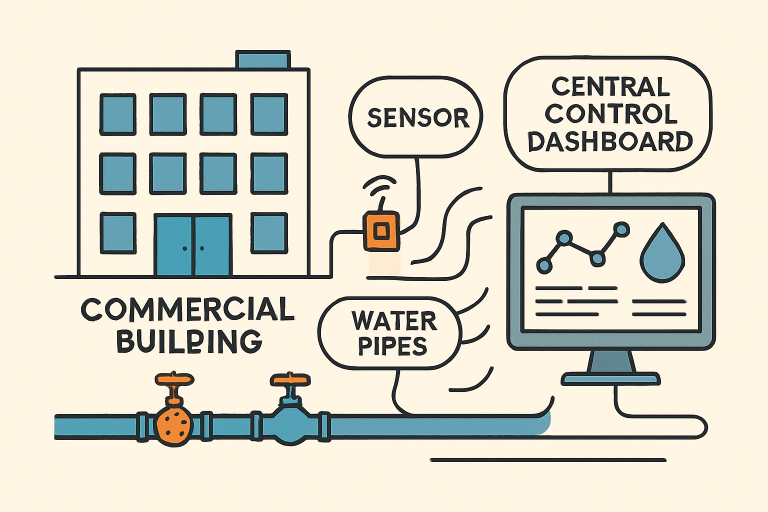
One of the fastest-growing advantages of smart plumbing is predictive maintenance. IoT-enabled pipe sensors, automated meters, and cloud-connected dashboards all provide facilities teams with a constant stream of data on pipe integrity, water pressure, and fixture functionality.
By processing this data with artificial intelligence or machine learning, the system can forecast likely problem spots before they lead to leaks or failures. This proactive approach dramatically reduces unplanned outages and emergency repair expenses, which historically account for a substantial portion of a building’s operational budget.
According to research featured in Buildings.com, organizations that have transitioned to IoT-powered predictive maintenance have seen water consumption decline by over 20 percent and observed maintenance cost reductions of up to 40 percent. This measurable impact highlights the importance of digital transformation strategies for forward-thinking facility managers.
Integration with Building Management Systems
The real power of smart plumbing lies in its seamless integration with a building’s broader management ecosystem. When smart plumbing subsystems communicate with broader Building Management Systems (BMS), facility managers have unprecedented visibility and control. This interconnectivity enables not only centralized monitoring of water use and leak detection, but also automatic adjustments based on real-time occupancy or time-of-day schedules.
When paired with smart HVAC and lighting controls, whole-building efficiency improves, which is essential for achieving sustainability certifications such as LEED or WELL.
This unified approach also improves compliance by providing easy access to historic data and automated reporting, making it easier to demonstrate regulatory adherence and benchmark performance against industry standards.
Case Studies of Smart Plumbing Implementation
Practical examples are emerging worldwide as more developers and property managers embrace smart plumbing solutions. A notable case in Singapore saw the installation of a comprehensive smart system in a Grade A commercial tower. Over six months, the building cut its water consumption by 28 percent and reduced water-related maintenance costs by 35 percent.
Another example from a high-rise residential project demonstrates how IoT monitoring detected early leaks in concealed pipelines, preventing two costly water damage incidents and saving over $50,000 in repairs. These outcomes underscore the reliability and impressive return on investment provided by a well-executed smart plumbing rollout.
Challenges and Considerations
Despite the many benefits, there are significant considerations involved when transitioning to a smart plumbing system. Upfront investment is often higher than traditional plumbing installations, though lifecycle cost analyses reliably show a net positive return over time.
Integrating new technology with legacy building systems can present compatibility issues or require specialized retrofits and staff training. Data privacy is another critical factor, as continuous monitoring relies on secure networks and careful handling of information.
Stakeholders must also consider the resilience of smart systems to power outages or network disruptions. Proper planning, a clear technology roadmap, and selecting the right vendor partners are essential to ensuring a smooth, successful transition.
Future Trends in Smart Plumbing
Looking to the future of commercial building design, smart plumbing will only become more adaptable and scalable. Manufacturers are investing in modular, upgradable systems that allow for incremental technology adoption. This shift makes it easier to phase in upgrades, manage budgets, and accommodate evolving sustainability standards without major overhauls. Smart plumbing is therefore an integral part of the broader green building movement, making it easier to comply with both current and expected future building codes.
Ultimately, by embracing smart plumbing, commercial buildings can become more resilient, eco-friendly, and cost-effective. These systems are setting a new standard for what modern building infrastructure should deliver in terms of efficiency, savings, and future readiness.
Also read:
Building Strong and Efficient Floors: Innovative Approaches to Wood Floor Truss Design