Key Takeaways
- Integration of artificial intelligence (AI) and automation enhances operational safety and efficiency.
- Collaborative industry efforts lead to record-low incident rates in refineries and petrochemical plants.
- Advanced monitoring systems and data analytics play a crucial role in proactive safety management.
In the dynamic landscape of chemical processing and refining, achieving peak safety and operational efficiency is an ever-evolving challenge. As modern demands intensify and new risks emerge, industry leaders are harnessing technological innovations and collaborative strategies to safeguard their teams and optimize processes.
Recent initiatives, from the adoption of artificial intelligence to advanced data analytics, have set new benchmarks in both safety and performance for chemical plants and refineries. See how it works. These developments are changing the way plants operate by enabling real-time monitoring, predictive maintenance, and automated management of complex procedures.
By integrating cutting-edge solutions into their daily operations, industry players are not only complying with regulatory standards but also maximizing uptime and reducing costs associated with accidents and unplanned outages.
Bridging technology and expert collaboration is an industry-wide movement. Companies now leverage powerful digital tools and share safety insights through associations and initiatives, which have led to measurable improvements and industry recognition for outstanding safety records.
This article will explore the innovative practices shaping the future of safety and efficiency in chemical plants and refineries, as well as highlight the advances that are setting new standards worldwide.
AI and Automation in Refining Processes
Artificial intelligence and automation have radically transformed the refining sector, providing new ways to control complex operations and predict risks before they impact output or safety and efficiency. A breakthrough example comes from ENEOS Corporation.
By partnering with Preferred Networks, Inc., they launched a continuous autonomous operation of an atmospheric distillation unit for crude oil processing. This AI-guided system evaluates 24 separate operational factors and controls 13 valves at once.
The outcome is increased operational stability, reduced downtime, and higher production yields, far beyond the limits of manual processes. According to Bloomberg, AI-driven automation is rapidly becoming a staple in the world’s leading refineries.
Over the past several years, plant operators have witnessed significant returns from AI integration—examples range from enhanced throughput to the detection of subtle process anomalies.
Today’s autonomous control systems can rapidly recommend or even apply corrective actions in real time, preventing the escalation of abnormal conditions. Maintenance is also revolutionized by these technologies, with machine learning algorithms identifying when assets are trending toward failure and prompting timely repairs.
An additional benefit is the streamlining of reporting and documentation, allowing operators and engineers to focus attention on higher-value tasks. Industry experts anticipate even wider adoption as AI models become more explainable and user-friendly, making them accessible across all levels of plant operation.
Industry Collaboration for Safety Improvement
Improving safety and efficiency in high-risk industries depends greatly on collaboration, shared standards, and transparent reporting. The American Fuel & Petrochemical Manufacturers (AFPM) exemplify this approach with their Annual Safety Awards program, which honors refineries and petrochemical plants with exemplary safety performance.
Facilities recognized by AFPM demonstrate lower incident rates and serve as benchmarks for best practices. Such collaborative efforts not only drive the adoption of proven safety measures but also foster a culture where continuous improvement is valued and rewarded.
This culture of collaboration is further enhanced by the global exchange of safety data, lessons learned, and joint training exercises. Industry consortia, such as the Center for Chemical Process Safety (CCPS), regularly publish guidance documents and host forums where companies openly share experiences, including near-miss events and successful risk mitigation tactics.
By pooling resources and knowledge, member organizations can accelerate the deployment of breakthrough safety solutions. Many companies now participate in cross-industry benchmarking programs, enabling them to objectively measure their performance against peer organizations and to close safety gaps proactively.
These collaborative models have contributed to the development of robust emergency response systems, standardized hazard identification tools, and the dissemination of innovative safety technologies worldwide.

Advanced Monitoring Systems
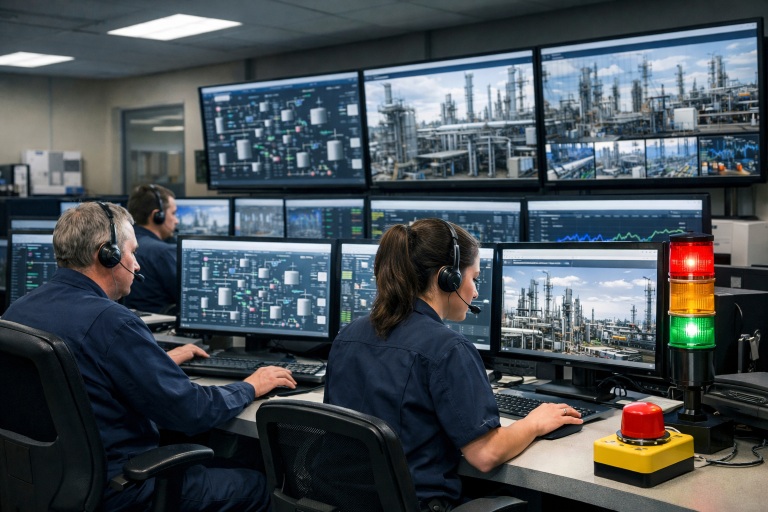
Real-time monitoring has become a baseline expectation in modern refineries thanks to advanced systems that instantly track critical safety parameters. Valero Energy is a leader in this area after deploying sophisticated measurement technology to monitor hydrofluoric acid (HF) in its alkylation units at seven refineries.
This upgrade gives operators instant insight into HF levels, supporting faster response to potential hazards and enhancing both safety and environmental performance. The move toward automated monitoring systems, including advanced gas detection and asset health sensors, reflects a broader industry shift toward zero-incident operations.
Implementing such technology significantly reduces the probability of catastrophic events by catching potential issues while they are still manageable.
Next-generation monitoring platforms now employ wireless sensor networks, remote diagnostics, and digital twins—virtual replicas of physical assets—to visualize plant conditions at a glance.
Operators can simulate different scenarios or stress-test their emergency protocols safely, before an actual event occurs. In addition, the integration of wearable technologies, such as smart helmets and connected safety vests, ensures that front-line workers are constantly aware of potential hazards in their immediate environment.
With increased sensor fidelity and new data sources, predictive alarm and trip systems can issue early warnings for abnormal conditions, helping reduce operational and environmental risks and protecting both human and asset safety.
Leveraging Data Analytics for Safety
Data analytics enables chemical facilities to shift from reactive responses to proactive risk management. By aggregating vast volumes of sensor readings and process statistics into cloud-based platforms, operators gain real-time situational awareness across vast and complex assets.
Owens Corning serves as a compelling example, having implemented a low-code digital platform to integrate sensor data and enable immediate visibility into its asphalt processing tanks. Such innovations not only support ongoing compliance but also reduce risks, drive timely maintenance, and create a data-driven feedback loop for continuous safety improvement.
These analytics platforms empower decision-makers to set and meet ambitious safety goals, keeping pace with evolving industry demands.
Advanced analytics go beyond basic reporting. With machine learning and AI, plants can spot hidden trends and correlations that may escape traditional analyses. Multivariate statistical methods allow teams to investigate the root causes of process deviations and near-misses, building a more comprehensive understanding of risk across the enterprise.
Furthermore, customizable dashboards and mobile alerts keep stakeholders informed no matter where they are, ensuring that timely decisions can be made even in distributed or multi-site operations. The flexibility of cloud-based analytics enables rapid scaling as new data sources are added, and fosters a continuous improvement loop where insights from one plant can be shared and implemented across entire networks.
Conclusion
As the chemical and refining industries continue to advance, embracing innovative safety and efficiency practices is critical. AI-driven automation, collaborative safety programs, advanced monitoring systems, and robust data analytics are transforming plant operations globally.
These measures not only protect workers and the environment but also drive operational excellence, positioning facilities to meet future challenges with confidence.
Looking ahead, the industry’s commitment to ongoing improvement and digitalization is expected to drive further milestones in productivity, safety and efficiency. The combination of real-time data, transparent cross-company reporting, and scalable digital solutions will empower operators to address tomorrow’s energy, environmental, and occupational challenges.
Companies that prioritize these advancements today will be better positioned to lead in a highly competitive and regulated marketplace, extending their influence well into the future of industrial safety and efficiency.
Also read: How Smart Businesses Prepare for Growth Before It Happens