- Key takeaways
- First question: did your dog stop eating kibble suddenly?
- Why wet food can be more appealing than kibble
- Toppers, mixers, and complete foods are not the same
- How toppers can reinforce a kibble hold-out
- Decide what outcome you actually want
- Compare the main solutions
- A practical reset plan for a medically cleared adult dog
- How to tell whether the plan is working
- Frequently asked questions
- Conclusion
Your dog noses the kibble, walks away, then races back the second a can pops open. Sound familiar? You’re not alone. When a dog refuses to eat kibble but eats wet food, the cause can be pain, smell, or a habit we unknowingly reward by “upgrading” dinner. In the next few minutes you’ll learn how to rule out medical red flags, see why moist meals win the sniff test, and choose a feeding plan (kibble-only, measured mix, or full wet diet) that fits both your dog and your budget.
Key takeaways

- Treat a sudden refusal of dry kibble as a medical red flag: call your vet before you tinker with the menu.
- Read the label: dry, wet, and fresh foods can all be complete and balanced if the AAFCO adequacy statement says so.
- Cap extras: keep toppers and treats under roughly 10 percent of daily calories (WSAVA nutrition guideline).
- Stay consistent: offer one recipe at set meal times; predictable routine ends the “hold-out for something tastier” cycle.
First question: did your dog stop eating kibble suddenly?

Sudden change versus lifelong preference
A dog that has never liked dry food tells a different story from one that crunched happily yesterday and balks today. Overnight refusal often signals pain, nausea, or food that smells “off,” so treat it as a medical clue, not a personality quirk. Ask what shifted in the past 48 hours: a new bag, dental work, antibiotics hidden in yesterday’s meal? A single “yes” moves the problem from “picky” to call the vet first. Once your vet has cleared health concerns, the Cornell Riney Canine Health Center guide to prescription-food refusal lists the palatability tricks worth trying: warm the food, add water, switch texture or brand, or make the dog work for a few pieces.
Signs the mouth hurts
- Drops a kibble, then abandons it
- Chews on one side only
- Stringy drool, reddened gums, sour breath
- Ignores crunchy treats yet laps up soft pâté
A bowl that once vanished in two minutes but now takes ten points to effortful chewing: time to book the clinic, not browse new flavors.
Red flags that mean “phone the vet”
Lethargy, repeated vomiting or diarrhea, difficult breathing, a tense or bloated belly, or a dog that yelps when you touch its abdomen shift the issue into urgent-care territory; PetMD’s guide to appetite loss lists these as reasons to see a vet at once, and says any dog that refuses food for more than 24 to 48 hours should be seen. Bloody stool, sudden weight loss, tremors, or refusal of every high-value treat belong on the same call-now list.
Audit the food itself
Before blaming the dog, inspect the bag:
- Packaging: torn seam, loose zipper, or roll-top left open invites humidity that dulls aroma.
- Dates & lot code: confirm the “best by” date and keep the original bag inside any storage bin so lot details travel with the food (FDA storage guidance).
- Smell test: musty, oily, or sour odor signals oxidized fats, comparable to rancid potato chips.
- Second opinion: if another pet also walks away, the issue is likely the food, not the eater.
Return questionable product and start fresh rather than launching a behavior campaign around stale kibble.
(If your dog refuses dry kibble but still devours wet food, jump to the next section on why moist meals win the sniff test.)
Why wet food can be more appealing than kibble
Stronger aroma
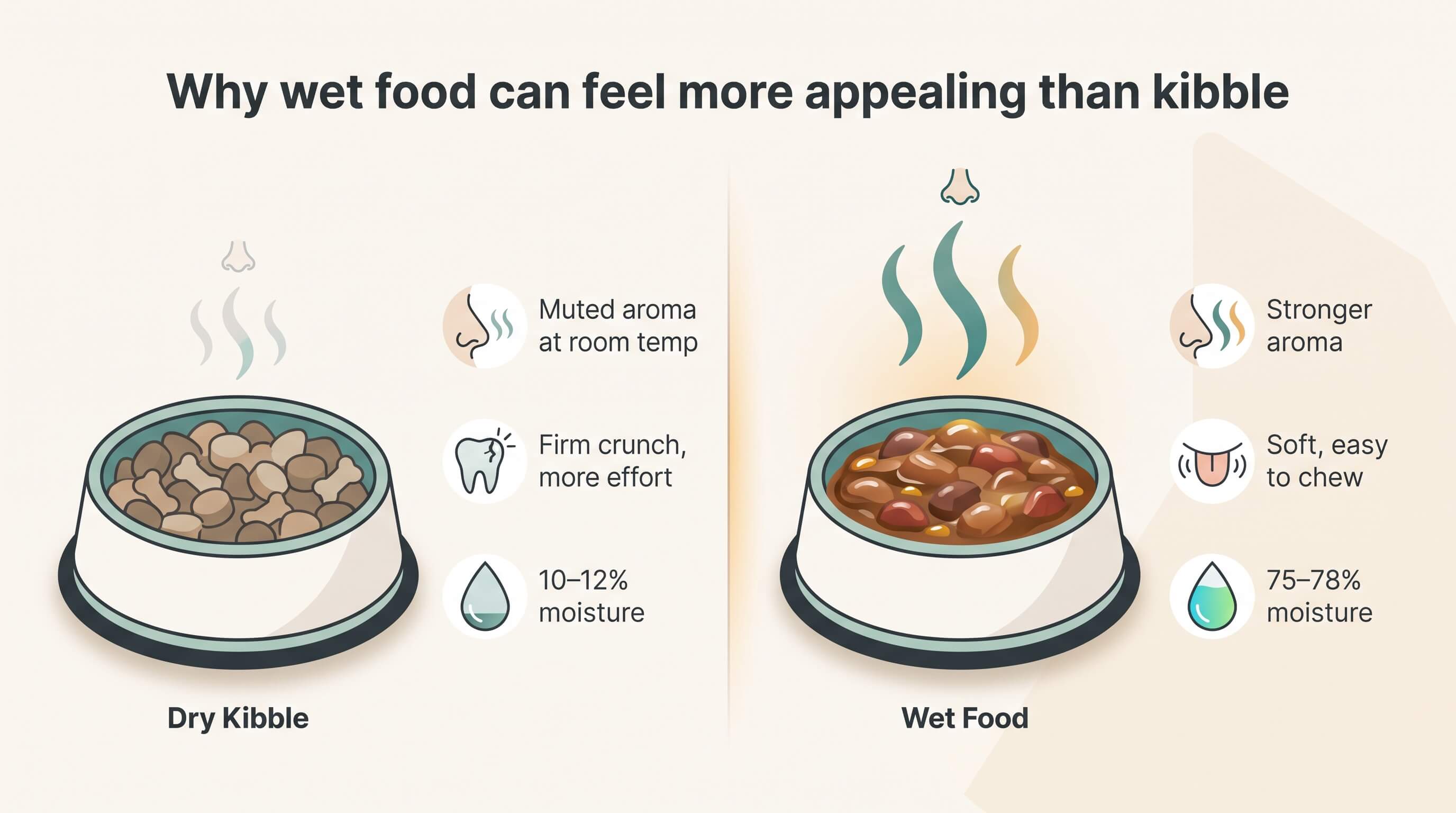
Pop a can and scent billows out long before the bowl hits the floor. Dogs lead with their noses; a 2023 review in the journal Animals notes that in dogs, odor preference has been identified as the likely driver of palatability, with dogs picking their preferred bowl before tasting. Kibble hides much of its fat-based aroma inside a dry shell that only releases when moisture or heat is added, so the same nutrients smell muted at room temperature.
If age dulls your senior’s sense of smell or allergies stuff up the nose, that louder scent cloud can cut through the haze and spark appetite.
Softer texture and easier chewing
Wet food collapses under the tongue, while kibble fights back. Tender pâté spares teething puppies, seniors with weaker jaw muscles, and flat-faced breeds that struggle for leverage. Because relief is instant, many dogs learn a simple rule: skip the hard stuff, win the comfy meal; no flavor rotation will out-compete discomfort until texture changes.
Moisture, warmth and mouthfeel
Canned diets average 75-78 percent moisture compared with 10-12 percent in typical dry food, according to the FDA. That built-in water not only hydrates each bite but also carries flavor compounds to the taste buds. Serve the food at body temperature after a brief warm-up and aroma intensifies even more.
Variety matters, too: gravies invite licking, loaf yields to gulping, shreds mimic tearing prey, while most kibble delivers a single, uniform crunch. More textures mean fewer boredom cues and, for many dogs, higher enthusiasm at the bowl.
Toppers, mixers, and complete foods are not the same
Supplemental toppers
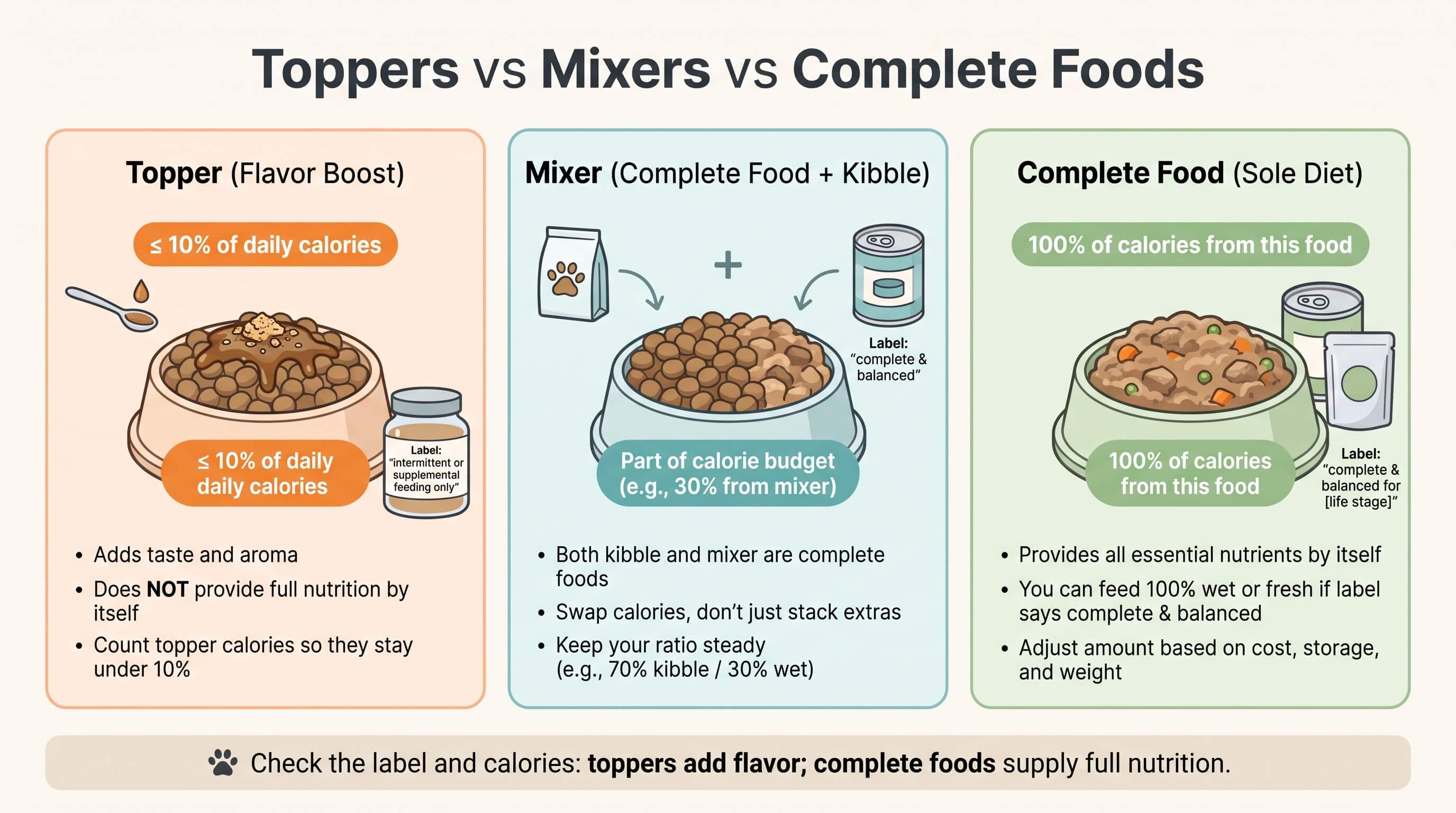
Drizzling broth or sprinkling freeze-dried liver adds flavor, not full nutrition. Think of the bowl as a calorie pie: treats, scraps, and toppers should stay under about 10 percent of daily calories, a cap the WSAVA nutrition guidelines recommend so extras don’t unbalance the main diet. Most products even say “for intermittent or supplemental feeding” in fine print. Measure with a spoon, log those calories, and if you hide medicine in food, borrow from the topper budget instead of piling on. A fixed scoop keeps the perk predictable and stops your dog from bargaining for more.
Using a complete wet or fresh food as a mixer
Sometimes you need more than a flavor spark. A complete and balanced canned or gently cooked food can stand in for part of the ration, but only if you swap calories rather than stack them. Step one: calculate total calories. Step two: slide those calories, say 30 percent, to the wet food and subtract them from kibble. Keep that ratio steady so dinner stops feeling like an auction for tastier tidbits.
Feeding 100 percent wet or fresh food
A dog that hates crunch isn’t doomed nutritionally. Any diet labeled complete and balanced for the right life stage can stand alone: canned pâté, a raw-look roll, or a gently cooked subscription food such as Bramble pets dog food, which is formulated by board-certified veterinary nutritionists, formulated to meet AAFCO adult-maintenance profiles, free from beef, dairy, and chicken, and shipped frozen in vacuum-sealed pouches so it replaces kibble outright rather than sitting on top of it. Expect lifestyle trade-offs:
- Cost: a 50-lb dog eating $2/day in kibble may need $4-$6/day in canned food and $6-$10/day or more on a fresh-food subscription.
- Storage: clear fridge or freezer space for open cans, trays, or chubs.
- Hygiene: wash bowls promptly; protein-rich wet food spoils faster than dry.
Transition over one to two weeks, holding each step until stools stay firm; Bramble, for example, publishes a 14-day schedule of 25 percent for days 1 to 5, 50 percent for days 6 to 10, and 75 percent for days 11 to 14 before going all-in. Freeze one day’s backup so a shipping delay never forces an emergency menu change.
Prescription-diet exception
Therapeutic foods are medicine. Even a spoon of gravy can dilute the nutrient profile your vet chose on purpose. Many lines offer canned textures or smaller kibbles; ask the clinic before you improvise with toppers. Until you get the green light, treat every unapproved add-on as an unscheduled dose change and stick to the plan.
How toppers can reinforce a kibble hold-out
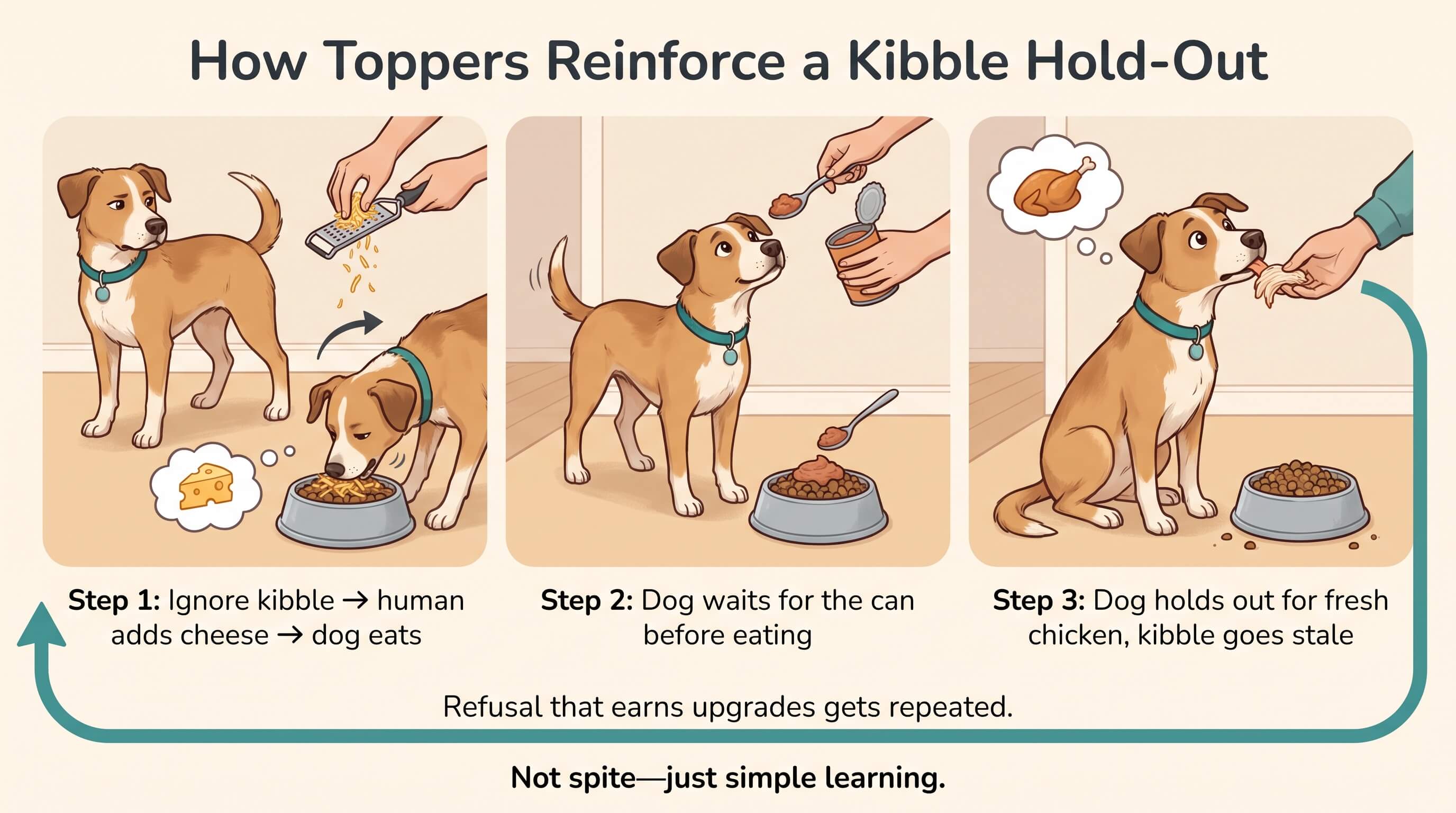
The reinforcement loop
Add cheese once, and your dog learns: ignore kibble → get upgrade. Purina notes that offering multiple menu options to a finicky eater can reinforce picky habits.
Escalation happens in three tidy steps:
- Cheese on kibble → bowl empty.
- Canned food mixed in → dog waits for the can.
- Fresh chicken hand-fed → kibble goes stale.
Break the cycle with one rule: one recipe, one meal window. We’ll cover the reset plan next.
Not spite, just simple learning
Dogs connect actions to outcomes. Refusal that earns tastier food feels efficient, not defiant. Calling the dog “stubborn” invites scolding but teaches nothing; calm consistency resets the pattern faster.
The visible-dollop problem
A topper layered like cupcake frosting is easy to lick off. Switch to a measured, thin coating and stir until every piece shines; no more mining for treasure, only eating the meal.
Other ways we accidentally reinforce refusal
- Hand-feeding after the bowl sits untouched
- Showering treats between missed meals
- Rotating three kibbles in a week
- Family members breaking the “no extras” pact
- Dramatic coaxing that turns dinner into a show
When it’s not a training issue
Persistent refusal plus dental pain, nausea, hidden medication, or life stress means health first, behavior second. Rule those out before running the reset plan.
Decide what outcome you actually want
Goal A: return to dry kibble
Crunch may suit your budget, storage, and travel plans, but only if the dog learns that kibble means dinner, not a negotiation.
- Portion reality check. Weigh one day’s ration on a kitchen scale; a scoop that looks level is often well over the brand’s feeding chart.
- Meal window. Offer the bowl at set times and lift it after about 20 minutes, a schedule Purina also recommends for picky eaters.
- Low-drama tweaks. Warm water, puzzle bowls, or a quick game before meals can boost aroma or make eating feel earned.
- Track weight weekly. Stable weight plus an empty bowl tells you the reset worked; sudden loss flags pain or illness.
Soft bites for the mouth, hard bites for the wallet. Pick a calorie split, say, 70 percent kibble / 30 percent canned, and stick to it.
- Do the math first. A typical 13-oz wet can delivers about 350 to 450 kcal; subtract those calories from the kibble ration.
- Stir, don’t layer. Coat every piece so your dog can’t lick off gravy and leave the crunch.
- Same 20-minute window. Routine prevents “one more spoonful” haggling.
- Adjust every two weeks. Trim wet food if weight creeps up; add a spoon if it drops.
Goal C: move to a complete wet or fresh diet
When a dog refuses to eat kibble but eats wet food and medical or personal factors agree, a full wet diet is fine, if the label says complete and balanced for your dog’s life stage.
- Portion shift. Wet formulas are about 75-78 percent moisture, so calories per gram are lower. A 75-lb retriever may need four cans a day, while a 10-lb terrier empties half a can.
- Storage & safety. Unopened cans live in the pantry; leftovers refrigerate within two hours. Wash bowls daily and freeze a spare day’s supply for travel or shipping delays.
- Gradual transition. Mix 25 percent wet for the first few days, then 50, then 75, holding each step until stools are firm. Most manufacturers advise 7 to 10 days; fresh-food makers such as Bramble publish a 14-day version with each step held about five days.
- No back-sliding for “variety.” Consistency keeps digestion steady and prevents a new cycle of selective refusal.
Pick the goal that fits your household, post it on the fridge, and let every family member play by the same rules.
Compare the main solutions

Warm water or softened kibble
Call this the five-second makeover: same food, new aroma and texture.
- Add warm water. Boil the kettle, let it cool a minute, then drizzle just enough to coat the kibble. Wait two minutes; the pellets swell, oils rise, and steam carries meaty scent to your dog’s nose.
- Dental litmus test. If your dog devours the softened bowl but ignored the dry one, sore teeth or jaws were probably part of the problem.
- Safety first. Discard any moistened kibble after about 30 minutes. Rinse the bowl and let it air-dry before the next meal.
Softening costs pennies and zero fridge space, so run this gentle experiment before buying new formulas. If it works long-term, you’ve solved the dilemma without changing diets.
Different kibble size, texture or flavor
A dog that refuses kibble but eats wet food may simply find the pellets hard to chew or bland to smell.
- Size matters. Large-breed formulas use chunky triangles; small-breed diets shrink to pea-sized bites that glide over molars.
- Texture boosts. Some premium kibbles wear a fat or freeze-dried meat coating that releases aroma like butter on rice.
- Flavor swap, same brand. Switching from chicken to fish can reignite interest because novel proteins smell different even before the bag opens.
Follow a 25-50-75-100 percent mix over 7-10 days to avoid GI upset, a schedule most manufacturers recommend for any food change. Resist opening a third bag if the second one meets a yawn; constant rotation trains a gourmet palate faster than any topper.
A measured supplemental topper
A small topper can lure a kibble-shy dog back to the bowl, if you keep it small. The WSAVA nutrition committee caps treats and toppers at about 10 percent of daily calories to avoid unbalancing the main diet.
- Do the math. Target 600 kcal? Extras ≤ 60 kcal, a tablespoon of plain pumpkin or a level scoop of freeze-dried turkey.
- Measure once. Use a kitchen scale or syringe; eyeballing doubles the allowance before you notice.
- Mix evenly. Coat every kernel so your dog can’t lick off the good stuff and leave the rest.
- Weigh weekly. Toppers pack calories into tiny volumes; trim the topper, not the complete diet, if pounds creep up.
Stay disciplined: adding layers of flavor re-opens the upgrade casino you just closed.
Complete canned food mixed with kibble
Canned food delivers aroma and softness without scrapping your kibble budget, if you swap, not stack.
- Split the calories. A typical 13-oz can supplies about 350 to 450 kcal. Decide on, say, 60 percent kibble / 40 percent canned, subtract one can’s calories from the day’s kibble allotment, and jot the gram amounts on a sticky note near the scoop.
- Mix thoroughly. Coat every kernel so your dog can’t lick off gravy and leave the crunch. Uniform bites mean uniform nutrition and still give teeth a workout.
- Mind the fridge. Cover leftovers, refrigerate within two hours, and discard after three days. Large breeds that burn through several cans can switch to tubs or rolls to cut waste and cost.
Used with discipline, a canned-and-kibble duo satisfies texture seekers, bumps up moisture, and lands roughly mid-way on the cost scale between all-dry and all-wet feeding, often enough to tempt a dog back to a balanced bowl.
Complete canned food as the sole diet
Switching to 100 percent canned can end the texture standoff, but plan for volume and budget.
- Calories & cans. Most complete canned formulas run about 350 to 450 kcal per 13-oz can, so check your label. A 50-lb dog needing 1,000 kcal empties two to three cans a day; Cornell notes some large dogs need as many as five 12-ounce cans. At $2-$4 per can, daily cost ranges $4-$20.
- Moisture boost. Canned food is 75-78 percent water, so each bite hydrates but delivers fewer calories, great for dogs that need larger, slower meals or extra fluids.
- Stool & weight watch. Higher moisture can soften stools; weigh your dog monthly and adjust portions.
- Dental reality. With no crunchy bits, plaque control shifts to daily brushing, VOHC-accepted chews, and regular cleanings.
- Food safety. Store unopened tins in a cool pantry; refrigerate leftovers within two hours and discard after three days. A silicone lid keeps odors contained.
If canned food checks every box (palatability, hydration, convenience), lock in the routine and review body condition monthly. When weight, energy, and labs stay on target, congratulations: you’ve found your new normal.
A practical reset plan for a medically cleared adult dog

Step 1: establish a baseline
Track three days: grams served vs. left after 20 minutes, every treat, stool notes, and energy. Weigh your dog on day 1 and day 3; this is your control group.
Step 2: total the calories
Pull kcal from every label: kibble, canned, treats, dental chews, pill pockets. Subtract unavoidable extras first, then split the remainder into scheduled meals. Post the math on the fridge so the whole family sticks to it.
Step 3: pick one meal plan for two weeks
- Kibble only
- Fixed mix (e.g., 70 percent kibble / 30 percent canned)
- Complete wet or fresh only
Lock it in; variety re-opens negotiations.
Step 4: set predictable meal windows
Serve breakfast and dinner at the same times. Bowl down about 20 minutes; lift leftovers without comment. Grazing never starts. Puppies, diabetics, or toy breeds need vet-approved timing.
Step 5: stop escalating the reward
No cheese drizzle, no hand-feeding. Offer the pre-measured meal, lift it unchanged, repeat. Purina’s feeding guide says most healthy adult dogs adjust to the new plan after a few meals.
Step 6: taper toppers with a scale
Log current topper weight, cut 20 percent, replace moisture with warm water, hold for two meals. If intake stays solid, cut another 10-20 percent. Pause, not backtrack, if appetite dips.
Step 7: low-drama appetite boosters
Warm water (two tablespoons), chilled kibble on hot days, puzzle feeders, or feeding after a 10-minute walk nudge interest without new calories.
Step 8: define stop conditions
- More than 2 percent body-weight loss in a week
- Repeated bile vomiting, diarrhea, lethargy, pain on chewing
- Skips food and water for 12 hours, or any miss in high-risk dogs
Hit any red flag? Call the vet; this plan serves behaviour, not medical crises.
Run the protocol for 14 days, then review weight, stool, and refusal rate. A dog that once refused kibble but ate wet food should now eat the chosen menu on schedule, with no topping casino required.
How to tell whether the plan is working
Track objective measures
Numbers beat hunches. Weigh your dog weekly: same scale, same time, no collar. Stable weight or a gentle drift toward ideal body condition is a win.
Log:
- Percent of each meal eaten and time to first bite
- Stool quality (firm vs. soft/greasy)
- Energy spikes (“zoomies”) or slumps
A refusal rate dropping from 50 percent to 10 percent in seven days signals progress even if a few kibbles remain. Stool should stay firm; mucus or blood means call the vet. Energy that rebounds after breakfast confirms the reset fuels both body and mood.
Veterinary weight-management guidelines treat 1 to 2 percent of body weight per week as the most a dog should lose on purpose, so anything faster than that during a reset means the plan is starving the dog, not training it.
Success isn’t just an empty bowl
Pet-food labels are generous. If your dog hits ideal weight yet leaves a quarter-cup, celebrate: bright eyes, steady weight, and happy zoomies beat a mathematically spotless dish every day.
Frequently asked questions
Is it okay to feed a dog only wet food?
Yes, if the label says complete and balanced for your dog’s life stage. The FDA notes that this adequacy statement, not the format, makes a food a full diet rather than a treat; canned diets simply contain more water than dry kibble.
Advantages include built-in hydration, a softer bite for tender mouths, and rich aroma that tempts dogs who refuse kibble. Trade-offs are higher cost per calorie, more pantry and fridge space, and no abrasive crunch; plaque control relies on brushing or VOHC-accepted chews.
How do I read a topper, wet-food, or fresh-food label?
First, find the nutritional adequacy statement, one sentence that begins with “This food is formulated to meet…” or “Animal feeding tests substantiate….” That line means every essential nutrient is covered for the stated life stage and that the product can serve as the sole diet. If it’s missing (or says “intermittent or supplemental feeding only”), treat the product like a topper and keep it under the 10-percent-of-calories rule.
Next, match the life stage: growth, all life stages, or adult maintenance. If your household spans ages, choose an all-life-stages recipe and measure portions for each dog.
Finally, check calories. Convert everything to a per-day total for your dog, using a kitchen scale for accuracy. Trim or add about 10 percent and re-weigh in two weeks.
Remember: understanding the label stops a kibble refusal spiral from turning into a nutrition guessing game.
Conclusion
Dogs refuse kibble for many reasons: pain, smell, and well-rewarded habits top the list. Rule out medical problems first, inspect the food, and choose a single feeding strategy: kibble-only, fixed mix, or complete wet. Consistency, measured portions, and calm persistence reset even a seasoned hold-out’s expectations. When the bowl routine stabilises and your dog’s weight, energy, and enthusiasm line up, both of you can retire from the topping casino for good.