-
First, understand the truss-plant automation ladder: every rung lifts output, and you can stop where the payoff erases today’s constraint
- Level 0 manual production
- Level 1 assisted handling & visual guidance
- Level 2 automated cutting or jigging
- Level 3 integrated semi-automated flow
- Level 4 robotic assembly & plating
- Design-to-machine data handoff
- Cutting and material organization
- Setup and jigging
- Plate picking, placement and pressing
- Ejection, finish rolling and stacking
- Automated truss assembly equipment cost starts with total installed cost
- The hard benefits: what can be measured
- The hidden benefits that still affect the business case
- How far should your plant automate?
- Three automation paths in the real world
- ROI walkthrough: turn production gains into cash flow
- Conclusion
The plant floor hums, yet orders still pile up. If you’re weighing overtime dollars against the price tag of automated truss-assembly gear, you’re in the right place. Over the next few paragraphs you’ll pinpoint your primary production constraint, pick the rung on the automation ladder that removes it, and run a no-spin ROI your CFO will sign off on. Ready to choose the smartest—not the flashiest—upgrade? Read on.
First, understand the truss-plant automation ladder: every rung lifts output, and you can stop where the payoff erases today’s constraint
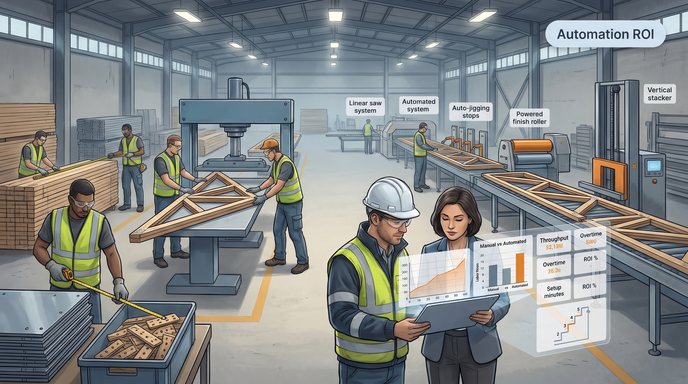
Most plants sit somewhere between hand-set jigs and full robotics. Knowing which rung you occupy, and which rung removes the bottleneck, keeps budgets lean and paybacks brisk.
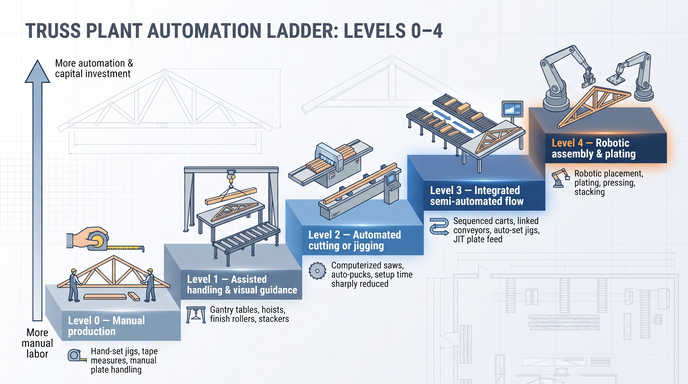
Level 0 manual production
Crews measure with tape, set jigs by eye, pull plates from bins, and press with a gantry or C-clamp. A new pedestal jig can cost under $100 k, yet setups drift, fatigue grows, and quality depends on veteran skill.
Level 1 assisted handling & visual guidance
Simpson Strong-Tie’s online truss fabrication equipment catalog lays out roof, floor and jack truss gantry tables along with finish rollers, vertical stackers and exit conveyors-the very plug-in modules that turn manual handling into assisted flow. Simpson Strong-Tie also bundles equipment installation, onboarding, staff training, and technical support with the machinery. Add hoists, conveyors, laser projection, a finish roller, or a vertical stacker, and head count often stays flat, back strain drops, and the table clears faster.
Level 2 automated cutting or jigging
Software drives the saw, and auto-pucks snap stops into place. Independent case studies reported by SBC Magazine show setup times falling from 20–30 minutes to under five for many roof patterns. For high-mix plants, that recovered hourage often adds another truckload per day.
Simpson Strong-Tie pairs its tables and presses with Monet DeSauw sawing and material-handling equipment, so cutting and assembly can be planned as one line.
A fast, software-driven saw can keep two assembly tables fed without overtime, so the plant’s new bottleneck shifts downstream to setup, not sawing.
Level 3 integrated semi-automated flow
Material carts arrive sequenced, plates feed JIT, jigs auto-set, the gantry presses, conveyors hand off to a stacker, and data flows from design to shipping without a second keyboard stroke. Labor falls, but the bigger gain is a drum-steady rhythm the scheduler can trust.
Level 4 robotic assembly & plating
Robots lift, place, plate, press, and stack. Labor per thousand board feet plunges; capital cost and downtime risk climb just as sharply. Recent publicly reported installs, according to SBCA Components, top $6 million for a two-table line and pay only when shifts are full, demand is steady, and tech support stands ready 24/7.
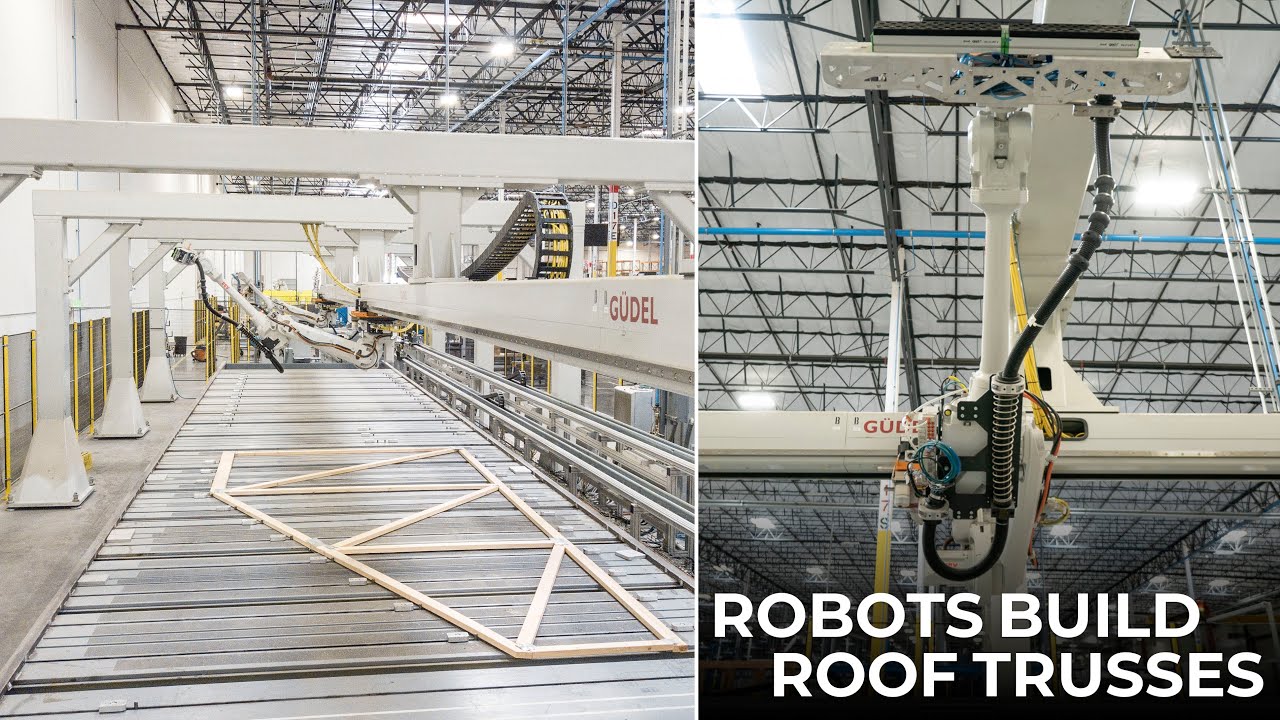
Plant your feet on the rung that frees today’s constraint, not the one that flatters a brochure.
Where manual and semi-automated truss production loses time
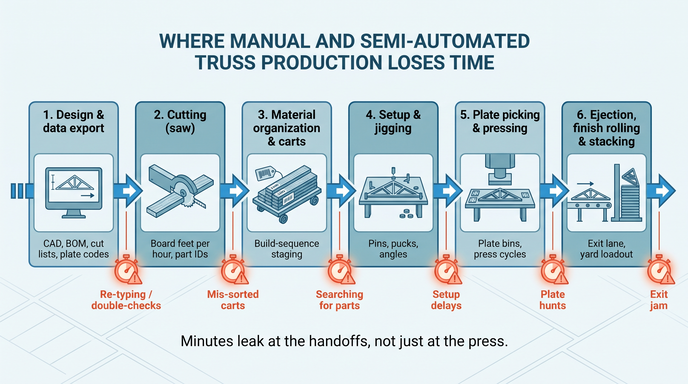
The pattern is clear: minutes leak at handoffs, not just at the press. Measure those leaks first; then target automation where the stopwatch proves it matters.
Design-to-machine data handoff
A crew can press trusses only as fast as information reaches the saw. Yet 48 percent of manufacturing companies use spreadsheets or other manual data-entry tools for production information. Each re-typed length or plate code carries a 1–4 percent average error rate, small on paper but big enough to stall a jig while someone double-checks a mis-keyed chord.
Streaming a ready-to-run file from design software flips the script.
- The saw queues every cut before the first board feeds.
- Laser projection replaces tape measures at the table.
- Dashboards update automatically, so the scheduler stops chasing verbal updates.
Tight data equals tight production; every later automation layer depends on getting this first handshake right.
Cutting and material organization
The saw is the metronome of a truss plant: when it stalls, every table downstream starves. In many shops, “lumber optimizing” at the linear saw creates mini-batches that leave builders sorting a tangled cart of chords and webs. Research shows that material handling and staging can occupy up to 87 percent of production time, forcing extra forklift trips across the floor.
A disciplined material plan reverses the loss:
- Boards arrive table-side in build sequence, bar-coded and labeled.
- The saw does not pause to clear a jam; carts roll out in FIFO order.
- Forklifts follow fixed lanes instead of improvised shortcuts.
Plants that reorganize flow—often with nothing more than rack space, colored tags, and a revised schedule—gain more capacity than an expensive new gantry. Before blaming the press (or pricing a robot), walk the path from blade to jig with a stopwatch; minutes lost there multiply faster than any servo can save them.
Setup and jigging
Setup is the stealth cost most owners miss. Each time operators pull pins, slide stops, and re-measure angles, the press head waits. One Australian plant, Engtruss, saw manual setups drop from about 20 minutes to roughly five after installing laser-guided auto-pucking, a 75 percent cut that made complex roofs faster to build.
A Sunshine Coast shop, East Coast Frames & Trusses, fitted a compact TrussMaker jig over a long weekend and recorded an average 30 percent production lift in its first week, without adding floor space.
If your veterans spend more time setting than pressing, the real constraint is not labour or lumber; it is the ritual of tape measures and pin boards. Automate that step first, and every board foot downstream moves sooner; no robot arms required.
Plate picking, placement and pressing
A high-speed table is useless while someone hunts for the right plate. In many plants the bins sit ten paces away, so operators pause, dig, and sometimes walk back again when the stack runs dry. One time study found that each manual “re-batch” of plates can stall production for up to 20 minutes, and a run of 80 trusses may require the pause four separate times.
Sequence-ready stations change the game. Automated collation systems feed the exact plate—in the correct orientation—seconds before the press head slides over. Operators focus on quality checks instead of scavenger hunts, the press cycles sooner, and misplaced plates that once triggered warranty callbacks disappear.
The stopwatch shows only minutes saved, but the shipping log feels the difference: remove the plate chase and the table moves from stop-and-go traffic to green lights all day.
Ejection, finish rolling and stacking
The last truss may be pressed, but the line still stalls if it has nowhere to land. In many plants operators muscle a 40-foot frame off the bed, twist their backs, and drag it to a sagging pile. While they struggle, the jig sits empty and the gantry idles.
Adding a powered finish roller and vertical stacker clears that bottleneck. The roller seats every plate as it pushes the truss clear; the stacker lifts, aligns, and racks the piece in seconds. One operator taps a button, turns back to loading chords, and the table is ready for the next setup.
OSHA logs show that manual material handling accounts for roughly one-third of recordable injuries in manufacturing each year. Automating the exit lane cuts those strains while recovering minutes the crew once spent wrestling product. Many shops find that a tidy discharge path delivers steadier daily output than an expensive new press, because the shift ends when the last truss is stacked, not when it is pressed.
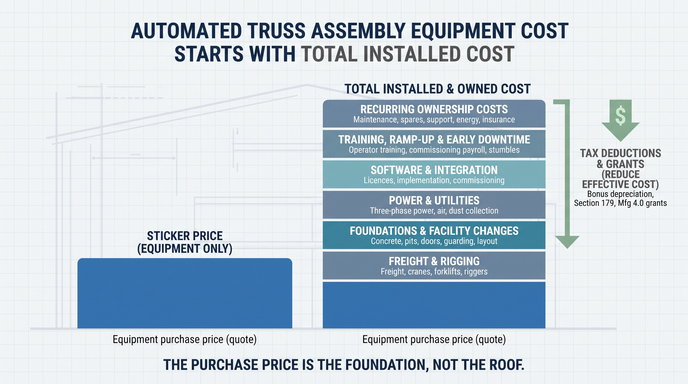
Automated truss assembly equipment cost starts with total installed cost
Sticker shock is real, yet the number on a vendor quote rarely tells the whole story. Before you add freight, foundations, or software, start with the direct equipment price itself.
- A new manual pedestal jig can cost about $92 k today.
- Bolt on a powered finish roller and you creep into the low-six-figure range.
- Auto-jigging or a computerized saw typically lands in the $250 k–$600 k bracket, depending on length and options.
Then the cliff appears. Integrated lines that cut, place, press, and stack without stopping have sat in seven-figure territory for years. Publicly reported robotic installs generally land in the $6 million to $10 million range.
Those headline numbers bundle many machines: retrieval saws, laser projectors, conveyors, robotic placers, finish rollers, vertical stackers. Break the bundle apart and each module adds capital but often subtracts minutes or labour elsewhere on the line.
Key takeaway: the purchase price is the foundation, never the roof. Stack freight, rigging, foundations, power, integration, and training on top, or the ROI that looked solid on paper will wobble before the first crate arrives.
Facility and installation cost
When the crates arrive, the real spending begins.
- Rigging crews roll in with forklifts and cranes.
- Freight invoices land, each stamped with a fuel surcharge.
- Electricians quote a new three-phase service.
- A concrete contractor warns that the roller pit needs thicker footers than the existing slab.
None of those numbers lived on the equipment quote.
Older plants may widen doors because a 40-foot table will not fit through a pickup bay. Guarding eats floor space, bigger compressors need larger air lines, and a dust-collector upgrade sneaks onto the PO because fine sawdust and servo drives struggle together.
How much does the pile grow? Benchmarks across hundreds of industrial-equipment projects show installation, utilities, and civil works add 30–50 percent on top of the machine price for custom cells and conveyor-based lines. Another field-install study pegs rigging and commissioning at 8–15 percent of equipment value for large capital machines.
Every extra square foot also carries opportunity cost. Park a table too close to lumber storage and forklifts weave tight turns, killing your safest travel lanes. Budget space like money: tape the outline, then walk the route a truss will follow from jig to truck. Hidden pinch points appear before concrete sets.
Rule of thumb: if the project touches floor, wall, roof, wire, or pipe, record a dollar next to it. Only then does the payback math stand on solid ground.
Software and integration
Hardware shines only when the data behind it flows cleanly. Yet industry surveys consistently show that integration and commissioning account for 30–50 percent of total automation project cost.
Think in three buckets:
- Cloud schedulers, vision analytics, and plate-collation controllers usually bill per seat or device, so fees rise with every new shift or station.
- Mapping part names, testing exports, and training users incurs professional-service rates.
- Ongoing support. Annual subscriptions cover updates, backups, cybersecurity patches, and the 2 am help-desk call when a nesting file stalls 100 trusses deep into Friday’s rush.
Skip any of these and a million-dollar table can sit silent because the database will not load. Budget the trio up front, bake them into ROI, and the software will quietly drive every board, plate, and robot move at the right second.
Training, ramp-up and downtime
Machines earn nothing until people trust them.
- Even user-friendly auto-jigging can take a morning to learn and a few days for software confidence. Full robotic cells often require 40–80 operator hours and 24–40 maintenance hours before go-live, according to BCIPA training surveys.
- Atlas Engineered Products spent several weeks moving from “power on” to sellable output while files were tweaked and crews learned real-time troubleshooting, a payroll cost the company baked into its ROI.
- Early stumbles. A dull saw blade or mis-read sensor can stop the line cold. Budget a starter kit of critical spares, remote-support access, and a written “manual fallback” so lost hours in month one do not wipe out margin.
Treat training, ramp-up, and early downtime as line items, not footnotes. When they sit beside the purchase price, the payback math tells the whole truth.
Recurring ownership cost
The meter keeps running long after the ribbon cutting.
- Preventive maintenance. NIST surveys show maintenance averages 1.8–5 percent of a plant’s replacement value and climbs sharply when schedules slip. Belts, seals, sensors, and hydraulic oil follow a calendar that does not care about your backlog.
- Software and support. Annual licences fund updates, backups, and cybersecurity patches that keep controls online.
- Robots draw steady amperage, compressors cycle harder for nail guns, and upgraded dust collectors spin whenever the saw feeds. Fold the extra kilowatt-hours and compressed-air load into the cash model.
- Insurance and spares. Higher replacement value lifts premiums; stocking a critical-spares kit lowers unplanned downtime.
- Automation eventually needs a technician who can read PLC ladders as well as lumber grades. Their salary belongs on the same ROI sheet as the machine, because skill keeps the lights green more reliably than any warranty clause.
Treat every recurring dollar like rent on the capacity you just bought. If cash flow still looks strong after these charges, the investment can weather real-world wear.
Tax deductions and grants
The tax code smiles on machines that make things. Under current U.S. rules you can expense 100 percent of eligible equipment placed in service after January 19, 2025 through bonus depreciation. Section 179 still helps smaller projects, but its top deduction begins to phase out once annual purchases exceed about $4.09 million for tax year 2026.
That math packs a punch. A $2 million semi-automated upgrade could trim roughly $800 000 of federal tax in year one, depending on profit and state conformity.
Geography can sweeten the deal. Manufacturing 4.0 grants in Maryland, Minnesota, Nebraska, and New Jersey, for example, offer $25 000–$250 000 and often cover up to 50 percent of eligible cost, but only if you apply before signing a purchase order.
Call your CPA and local economic-development officer before you cut a deposit check. Subtract confirmed credits or grants from installed cost, not from annual benefit. Cash today speeds payback tomorrow, but it never raises throughput on its own. Model both cases; if the upgrade pencils out only with free money, you are solving a tax problem, not a production one.
The hard benefits: what can be measured
Faster setup and changeover
Setup minutes steal capacity. On manual tables we have clocked 20 minutes to shift pucks for a hip set and another 10 minutes for the valley that follows. Multiply that by a dozen changeovers and four hours of an eight-hour shift vanish before a single plate is pressed.
Automation hands those minutes back. After adding auto-jigging, Superior Trusses cut pattern changeover to about five minutes and freed capacity for an extra truckload each afternoon.
The math is simple:
Minutes saved per setup × setups per shift × burdened labor rate
Save 15 minutes ten times a shift at a $32 burdened rate, and labor productivity jumps $800 per day, a gain you can annualize in any payback model.
More throughput from the same footprint
Throughput measures finished board feet per hour. Superior Trusses saw annual output rise 43 percent after its retrofit while table staffing fell by one-third. Because the plant shipped more product through the same doors, fixed cost per truss dropped and gross margin widened without a new mortgage.
Measure real mixes, not brochure rates, and balance each station so gains flow from saw to stacker.
Labor-hour and overtime reduction
Nonsupervisory wood-product workers averaged $25.25 an hour in 2026. Eliminating one of three table operators saved Superior Trusses roughly 1 600 direct labor hours a year. Consistent cycle time also erased most Saturday overtime, turning fatigue savings into payroll savings.
Accuracy, quality and material yield
Repeatable setups shrink the two-percent scrap pile toward one. Precise plate placement lets engineers reduce plate area, and auto-saws that print part IDs nearly eliminate mis-cuts. Fewer re-presses, tighter tolerances, and lower callbacks protect margin when lumber prices swing.
Safety and ergonomics
Manual lifting and hammering double the recordable-injury rate compared with the manufacturing average. Hoists, lift-outs, and stackers cut those strains, trimming workers’-comp costs and widening your hiring pool.
Production visibility and analytics
Modern controls log every saw cut and press cycle. Dashboards reveal utilisation, downtime causes, and queue length in real time. Supervisors redirect labour before the table starves; maintenance swaps a bearing before Monday’s scramble. Fewer expediting fees and lower WIP quickly repay the sensor package.
The takeaway: each benefit carries a stopwatch, a dollar sign, or a risk score you can plug straight into the ROI sheet.
Recruitment and retention
Jobs with fewer lifts, cleaner air, and touchscreen controls attract candidates who can program a CNC as easily as they can swing a hammer. Modernised plants report applications from people who once ignored truss work, and current crews stay because wrists ache less and career paths now include robot tech or line analyst. Lower turnover trims onboarding costs and keeps tribal knowledge inside the fence.
Succession and knowledge transfer
Three veteran jig-setters may retire next spring. Without automation, their angle-checking tricks retire with them. Software-driven setup captures that craft in repeatable files, so the midnight shift in Yard 2 builds the same truss the veterans built at noon in Yard 1. Managers spend less time firefighting and more time on the next efficiency gain.
Morale and employee confidence
When automation removes grunt work such as heavy lifts and frantic plate hunts, operators feel respected, not replaced. Absenteeism falls, cross-training uptake rises, and visitors sense pride when crews walk them past a laser-guided table instead of apologising for plywood jigs.
Customer and market benefits
Cutting lead time from three weeks to nine days gets a framer’s attention. Fewer field fixes build trust, so schedulers stop padding calendars for late deliveries. In crowded markets, a record of on-time, on-spec trusses wins bids even when raw-material prices match competitors.
Sustainability and data readiness
Large builders now request scrap and energy data along with price. Vision systems log every truss, and dashboards track off-cut weight and kilowatt hours. Showing a two-percent plate-steel reduction or lower scrap rate can tip the scale on public projects that score bids on waste intensity. Capturing those numbers costs little once sensors are wired yet protects future revenue when Scope 3 reporting rules arrive.
How far should your plant automate?
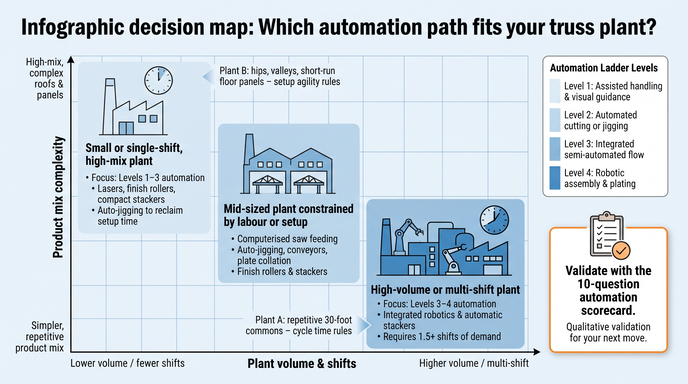
Small or single-shift, high-mix plant
Your crew builds everything from a jack to a forty-foot mono, sometimes within one hour. The constraint is rarely pressing speed; it is setup and material flow. Twenty minutes lost chasing pucks hurts more than a robot that can place 1 000 plates an hour.
Start with low-risk moves:
- Laser projection replaces chalk lines, trimming errors without changing headcount.
- A finish roller or compact stacker clears the bed so operators stop wrestling finished trusses.
- Auto-jigging follows; reclaiming 15 setup minutes on 15 patterns a day frees two to three production hours.
That trio often costs under $400 000, small enough for Section 179 yet big enough to delay talk of a second shift. Result: more trusses from the same floor and a payback measured in months.
Mid-sized plant constrained by labour or setup
Two tables, 50 employees, and growth outpacing hiring. The saw keeps up, but each new design drags as setters tweak stops by feel; overtime is routine.
Next rungs:
- Computerised saw feeding delivers parts in build order.
- Automated jigging cuts setup to about five minutes; one table now equals 1.5 manual lines.
- Plate collation and conveyors link flow so high-speed tables never wait on bins.
- Finish rollers and stackers clear product, avoiding a new constraint at the exit.
Capital: $1 million–$2 million. Payback usually relies on overtime saved plus deferred hires; trimming two operators per shift and removing most weekend work often clears finance charges inside 30 months.
High-volume or multi-shift plant
Your yard already runs 16 hours a day. The constraint is people—finding them, training them, keeping them alert at 2 am.
Integrated robotics—member placement, vision-guided plating, conveyors, automatic stackers—halve labour per 1 000 board feet and can double output without a building extension. Capital runs $6 million–$10 million.
Run three cases: high, base, and low utilisation. Robotics pay only when:
- Demand fills at least 1.5 shifts.
- Technical staff or a vendor contract guarantees rapid support.
- Upstream saws and downstream yards can match the pace.
If the cautious case still pays back in under four years, robotics can transform margin; otherwise they become expensive décor.
Product mix matters as much as plant size
Plant A churns repetitive 30-foot commons—cycle time rules, so a faster gantry or robotic placer fits.
Plant B survives on hips, valleys, and short-run floor panels—setup agility rules, so auto-jigging, lasers, and rapid plate collation pay bigger dividends.
Pull last year’s job file: count unique layouts and frequency of change. Match equipment to that truth and capital becomes a multiplier; ignore it and you might buy a sports car for a delivery route or a delivery van for a racetrack.
Ten-question automation scorecard
Open a spreadsheet with your leadership team, top operator, and accountant, then work through these prompts. Honest answers show whether the next automation rung is a “yes,” “wait,” or “no.”
- Which single station limits shipped board feet on a normal Tuesday?
- How many hours a week does that constraint sit idle because upstream or downstream tasks hiccup?
- Could you sell—or at least avoid overtime on—the extra capacity if that bottleneck vanished tomorrow?
- Which labour hours disappear, which shift to higher-value tasks, and which remain unchanged?
- Can saws, material staging, and stacking keep pace with the faster station, or do they become new choke points?
- Will the equipment handle your shortest members, heaviest chords, odd-angle plates, and seasonal species mix without manual rework?
- How much floor space, concrete, and power does the upgrade need, and where will forklifts travel once it is installed?
- Who owns preventive maintenance and software updates, and what is the plan when that person takes vacation?
- If the machine fails for four hours—or four days—what fallback ships trusses on time?
- When you model low-, mid-, and high-utilisation cases, does payback stay inside your comfort zone across all three?
Answer candidly and the scorecard will write your capital request—or your polite decline—before the demo video ends.
Three automation paths in the real world
Path 1: custom retrofit around an existing line
Superior Trusses faced the classic squeeze: an aging gantry and rising demand, yet no appetite for a multimillion-dollar replacement. An integrator added auto-jigging, material conveyors, and a finish roller while the original table frame stayed put. Staffing fell from three operators to two, and annual output climbed from about 15 000 to 21 500 trusses, a 43 percent lift that held for five years with minimal unplanned downtime.
Lessons learned
- Retrofitting preserves floor layout, foundations, and much of the wiring.
- Integration complexity must not outstrip support; make sure the vendor owns final debug, not the night shift.
- Five years of stable data outweigh launch-day hype.
Path 2: compact automated jigging
East Coast Frames & Trusses faced a gentler hurdle: veteran setters nearing retirement and no floor space for a second full table. A bolt-on auto-jigging kit installed over a long weekend and logged an average 30 percent production lift in its first week, without adding floor space.
Lessons learned
- A weekend install beats a month of phased demolition.
- Low footprint keeps forklifts and staging lanes intact.
- Early wins build trust; 30 percent more output on day four sells the next upgrade.
Path 3: integrated robotics
Large component manufacturers such as Menards and Drexel have invested in multimillion-dollar lines where robots lift every chord, place every plate, press, roll, and stack. Vendors report that these cells run with a fraction of the attendants a manual table needs, but ask for audited output data from a comparable plant before you rely on any brochure figure.
Lessons learned
- Commissioning lasts months, not weeks; every subsystem must handshake before sellable product rolls out.
- Support is a contract, not a phone call; budget annual service visits, remote diagnostics, and a shelf of critical spares.
- Product mix still rules: complex hips may slow, short members can challenge grippers, and heavy chords need tool swaps.
Robotics pay when demand fills at least 1.5 shifts, technical staff are on hand, and upstream or downstream gear can match the pace. Otherwise a seven-figure cell risks idling while operators chase a tripped sensor at midnight.
Installation to watch
Atlas Engineered Products commissioned Canada’s first fully robotic roof-truss line in October 2026. Crews are running live orders while integrators fine-tune cycle times. The public goal: 2× output and 50 percent less labour than a two-table conventional setup, with payback under 24 months. Atlas plans to release audited data after six months of production, giving every owner benchmarks to separate robotic reality from brochure claims.
ROI walkthrough: turn production gains into cash flow
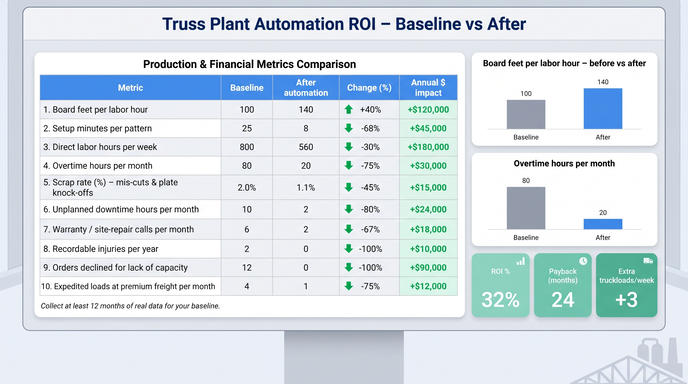
Start with a 12-month baseline
Before spreadsheets predict future wins, they must capture the stubborn present. Collect at least 12 months of hard numbers—no samples, no averages scribbled on a whiteboard.
Track, shift by shift:
- Trusses shipped and board feet pressed
- Direct labour hours, both straight time and overtime, by station
- Setup minutes between patterns
- Scrap from mis-cuts, cracked webs, or plate knock-offs
- Downtime events with honest root causes
- Warranty and site-repair calls, including travel hours
Add safety and quality:
- Recordable injuries and near-misses
- Failed plate-gauge checks or repress counts
Finally, gather the sales picture:
- Orders declined for lack of capacity
- Expedited loads shipped at premium freight
This baseline does two things. First, it shows where money leaks today, facts that silence “we’ve always done it this way.” Second, it sets the zero line for every ROI claim you will make. If the plant runs at 100 board feet per labour hour now and 140 after upgrades, that 40-percent gain is undeniable because both numbers share the same tape measure.
Without a baseline, credibility crumbles; with it, every later calculation stands on solid ground.
Conclusion
Automation is not an all-or-nothing leap. It is a ladder you climb one rung at a time, balancing capital against constraints and real market demand. Measure today, model tomorrow, and invest only where the stopwatch, payroll, and risk ledger agree. In a world where orders never stop, that discipline turns motion into momentum—and momentum into margin.