- How did we rank the programs, and why does it matter?
- Denver’s bariatric surgery scene in 2026
- Bariatric & Metabolic Center of Colorado (Parker)
- Colorado Bariatric Surgery Institute (Denver)
- Denver Health Bariatric Surgery Center (Downtown Denver)
- HealthONE Denver Center for Bariatric Surgery (Rose & Sky Ridge)
- Intermountain (SCL) Weight Loss Centers – Saint Joseph & Lutheran
- Kaiser Permanente bariatric program (members only)
- Compare the essentials at a glance
- Ready to choose your path?
Choosing a bariatric surgery team starts months before the operating room—during the teaching, coaching, and medical tune-ups that lock in safety.
Metro Denver hosts more than a dozen MBSAQIP-accredited programs, yet their pre-op pathways differ. We mined accreditation files, cost sheets, and patient reviews to uncover the six centers that prepare you best.
Accreditation sharply reduces complication and mortality rates, so it was our first filter. We then compared nutrition classes, psychological prep, transparent pricing, insurance help, and published outcomes to create this at-a-glance guide.
How did we rank the programs, and why does it matter?
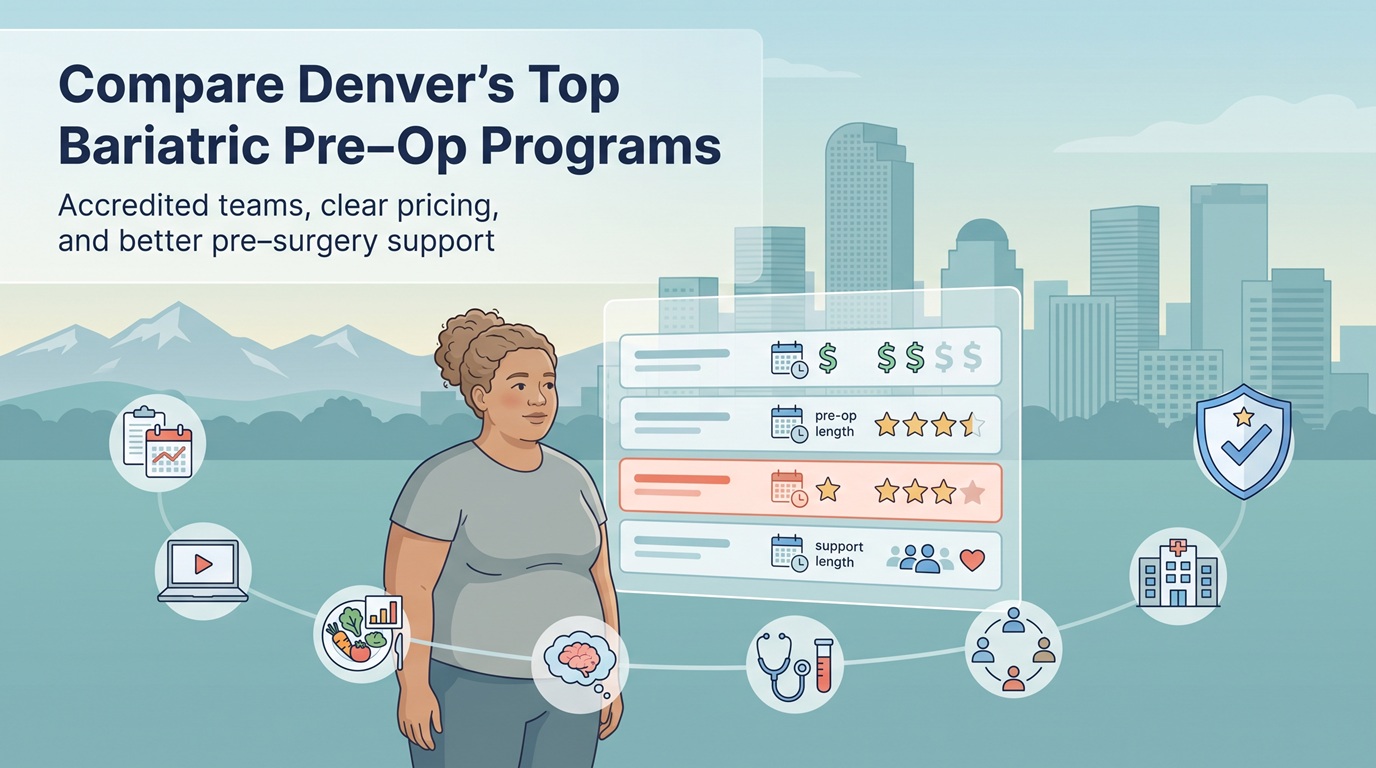
First things first: every center on our list carries the MBSAQIP seal. Accredited hospitals report far fewer complications and deaths than facilities that skip this voluntary audit—making accreditation a non-negotiable safety filter.
From that starting line we built a 100-point scorecard that mirrors the questions you ask when choosing a team. We assigned thirty percent to Accreditation and Safety. Program Completeness earned twenty percent because nutrition classes, psychological prep, and medical clearances create the runway to a smooth take-off.
Patient Satisfaction received fifteen percent, and Insurance and Self-Pay Friendliness took another fifteen percent, reflecting how easily real people can afford care. Innovation and Convenience counted for ten percent, rewarding teleclasses, FastTrack options, and new surgical techniques. Finally, Outcomes and Long-Term Support accounted for ten percent, covering published leak rates, readmissions, and after-care strength.

Why share the math? Transparency lets you see the yardstick before trusting the ranking. If a program excelled in three or more pillars and scored solidly in the rest, it earned a spot in the top six. Simple, data-driven, and fair.
Denver’s bariatric surgery scene in 2026
Metro Denver punches well above its weight in weight-loss care. A dozen hospitals now hold MBSAQIP accreditation, giving residents a rare luxury: you can drive less than an hour in almost any direction and still land at a nationally vetted bariatric program.

Competition pushes progress. In the past two years Denver Health secured adolescent accreditation, opening the door for teens as young as sixteen to get surgical help close to home. UCHealth rolled out robotic duodenal switch trials, and HealthONE shortened self-pay timelines to just six weeks for those who prefer speed over insurance paperwork.
Insurance coverage is keeping pace. Colorado Medicaid funds bariatric surgery that meets standard BMI and comorbidity rules, and major commercial plans tag many local centers as “Centers of Excellence,” trimming out-of-pocket costs for covered members.
The result is clear: price transparency is improving, wait-lists are shrinking, and patients now compare service details—such as virtual classes, bilingual coaching, and lifetime support—rather than pleading with a single hospital for a slot. It is a buyer’s market, and a side-by-side comparison has never been more useful.
Bariatric & Metabolic Center of Colorado lists a $12,250 sleeve bundle that folds the six-month class curriculum, counseling visits, surgery, and three months of follow-up into one posted price; the same page notes that lifelong support groups are available in person or via telemedicine. In other words, Denver patients can now evaluate concrete line-item benefits—not just surgeon names—before ever booking a consult.
Bariatric & Metabolic Center of Colorado (Parker)

Walk into BMCC and the first impression is calm precision. The program is housed inside Parker Adventist Hospital, an MBSAQIP Comprehensive Center, a credential linked to lower leak rates and near-zero mortality.
Preparation starts long before surgery day. You watch a free online seminar, confirm the bariatric surgery requirements, then partner with dietitians, psychologists, and exercise coaches who stay on speed dial for life. Most insurance patients move from seminar to operating room in about three to six months; self-pay clients can shorten that to eight weeks without skipping education.
Cost transparency is a headline feature. BMCC posts an all-inclusive sleeve package near $12,250 and a gastric bypass around $18,650, prices that cover the hospital, anesthesia, and ninety days of follow-up. Financing up to twenty-four months at zero interest keeps payments manageable when insurance is not in play.
Skill seals the deal. Medical director Dr. Joshua Long has completed more than one thousand bariatric cases with leak rates well under one percent, combining laparoscopic finesse with robotic tools for faster recovery. Patients consistently rate the experience 4.7 stars or higher, praising a “family feel” that makes big goals feel reachable.
Add lifetime support groups and bilingual services, and BMCC sets a high bar for Denver programs. If you want clear pricing, a high-volume surgeon, and a team that stays in your corner long after the scale settles, this center is a smart starting point.
Colorado Bariatric Surgery Institute (Denver)
If you link surgical confidence to case volume, CBSI delivers. Founder Dr. Thomas Brown has completed more than 6,000 bariatric procedures, many with the da Vinci robot that allows suturing through openings smaller than a pencil eraser. Patients often walk hospital corridors the same day and leave within twenty-four hours.
Education begins with a free monthly seminar that clarifies insurance paperwork, meal plans, and life after weight loss. Next you meet dietitians and a psychologist who identify obstacles early, so nothing stalls approval. Most insured patients reach the operating room in four to six months, guided by the insurer’s supervised-diet rule. Self-pay timelines shorten because you are not waiting on paperwork.
CBSI posts prices up front. Sleeve gastrectomy runs about $11,800 and gastric bypass about $18,200, totals that cover the surgeon, hospital, anesthesia, and ninety days of follow-up. CareCredit and in-house financing can spread payments over twenty-four months at zero interest.
The office feels like family inside a busy practice. Online reviews average 4.8 stars, with repeat praise for staff who “remember your story, not just your chart.” Parking can test patience, and popular surgeons book out weeks ahead, but clinical skill and transparent pricing outweigh those annoyances.
Choose CBSI if you want robotic precision, high-volume surgeons, and clear cost math before you commit to surgery.
Denver Health Bariatric Surgery Center (Downtown Denver)

Denver Health shows that a public hospital can match, and sometimes surpass, its private-sector rivals. It is the only Denver program accredited to operate on both adults and adolescents, a dual seal granted by the American College of Surgeons in late 2022.
The pathway here feels more like a college course than a checklist. Expect six to nine months of dietitian visits, psychological clearances, support-group attendance, and medical tune-ups before you reach the operating room. Patients who once dreaded the wait later rave about how “prepared, not rushed” they felt when surgery day finally arrived.
Cost is another highlight. Self-pay sleeves start near $13,000, the lowest sticker price in the metro, and the hospital offers zero-interest payment plans up to three years. Add in the fact that Denver Health accepts Medicaid, Medicare, and every major commercial insurer, and you have a program that says yes when others say “out-of-network.”
Clinical results keep pace with accessibility. Internal data show leak rates and 30-day mortality on par with Colorado’s best private centers, performance that helped the hospital appear on Newsweek’s 2025 list of top obesity hospitals.
If you value rigorous education, budget-friendly pricing, and a mission that treats every patient like family, Denver Health deserves a close look, especially for teens and Medicaid members who have few alternatives.
HealthONE Denver Center for Bariatric Surgery (Rose & Sky Ridge)
Sometimes speed matters. HealthONE’s FastTrack pathway can move a self-pay patient from first consult to surgery in as little as six weeks, the shortest timeline in Denver.
Quick does not mean cutting corners. Surgeons Dr. Frank Chae and Dr. Michael Snyder each bring thousands of bariatric cases to the table, and they operate inside full-service hospitals stocked with ICUs and bariatric-size equipment. That mix allows them to accept higher-risk patients while still matching national outcome benchmarks.
The pre-op journey flexes to your needs. Insurance patients follow the standard three- to six-month supervised-diet playbook. Cash patients compress the same education—nutrition class, psych evaluation, medical clearances—into a tighter calendar, skipping only the insurer’s paperwork.
Budget transparency needs homework. The website highlights a $4,500 surgeon fee for gastric sleeve, but facility and anesthesia bills lift the true all-in price closer to $15,000. Always request an itemized quote so the final number matches your budget.
Patient reviews praise quiet recovery rooms and nurses who make pain control feel “effortless.” A few mention big-system bureaucracy, with paperwork bouncing between offices. If you want veteran surgeons, hospital-level resources, and the option to move fast, HealthONE delivers, provided you keep a close eye on the billing sheet.
Intermountain (SCL) Weight Loss Centers – Saint Joseph & Lutheran
If you prefer a slower, hands-on journey with one nurse navigator who knows your name, SCL’s faith-rooted program fits the bill. Both Saint Joseph Hospital in Midtown and Lutheran Medical Center in Wheat Ridge carry MBSAQIP Comprehensive badges, yet still feel like neighborhood clinics.
The process is personal from day one. A navigator maps your entire pre-op plan and becomes your direct line for questions about labs, insurance forms, or the best blender for protein shakes. Typical runway: four to six months, driven more by thoughtful prep than paperwork delays.
Insurance alignment is a quiet superpower here. These centers partner closely with Kaiser, Medicare, and Medicaid, so prior-auths sail through faster than at many private clinics. Self-pay quotes hover near $18,000 to $20,000, higher than budget leaders, but interest-free hospital financing softens the blow.
SCL leans into whole-person care. Dietitians tackle food triggers, psychologists explore emotional eating, and chaplains offer spiritual support if you want it. Patients thank surgeons such as Dr. John Raheb and Dr. Katayun Irani for “listening first, cutting second,” a mindset reflected in stellar 4.9-star internal ratings.
For anyone who values bedside empathy over racing to the operating room, Intermountain’s Weight Loss Centers provide wrap-around support that lasts long after the final staple dissolves.
Kaiser Permanente bariatric program (members only)

Kaiser’s bariatric pathway is less a single clinic and more a coordinated network. Everything lives under one insurance umbrella, from primary-care tune-ups to post-op lab checks, which keeps the journey orderly for members while remaining closed to non-members.
Preparation centers on the Options weight-management course, a 16-week series covering nutrition, exercise, and mindset. Graduates often lose 20 to 30 pounds before surgery, a built-in safety boost when it is time to operate. Skip the class and you do not advance, so plan for the extra calendar time.
Surgeries take place at partner hospitals such as Saint Joseph or Lutheran, both MBSAQIP Comprehensive Centers, with Kaiser surgeons like Dr. Debra Davis-Merritt at the helm. Because payments run through your Kaiser plan, out-of-pocket costs can be surprisingly low; sometimes you pay only a hospital copay.
Patients praise the smooth hand-off between departments: your endocrinologist, dietitian, and surgeon view the same chart in real time. Critiques focus on bureaucracy—scheduling feels scripted, and speeding up the timeline is nearly impossible.
For Kaiser members who want a one-stop shop, deep pre-op education, and minimal surprise bills, this program stands out. Everyone else will need to choose from the other five centers on our list.
Compare the essentials at a glance
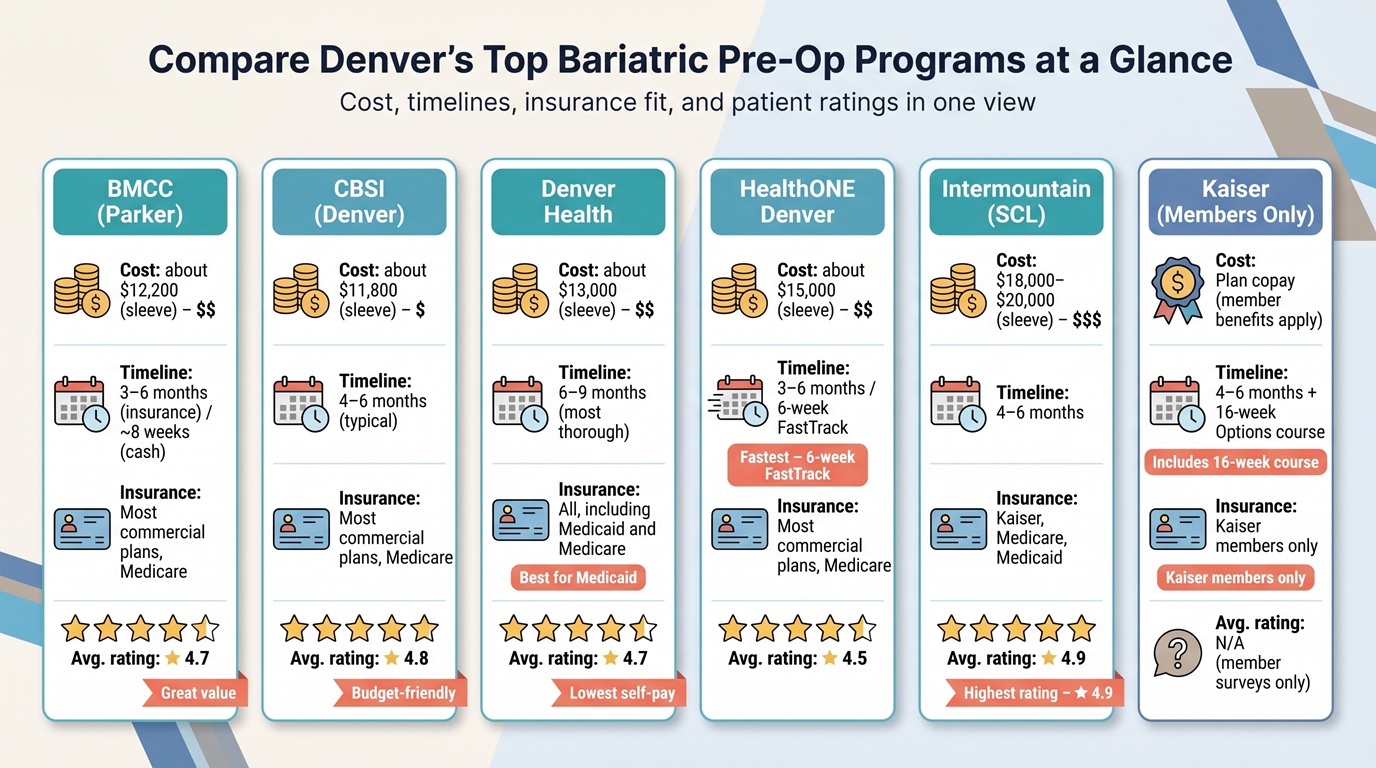
We have covered a lot of ground. If your head is spinning, this snapshot lines up the six programs on the numbers that matter most: accreditation, pre-op timeline, cost, and patient ratings. Scan the grid, note the rows that match your priorities, then return to the full profiles for details.
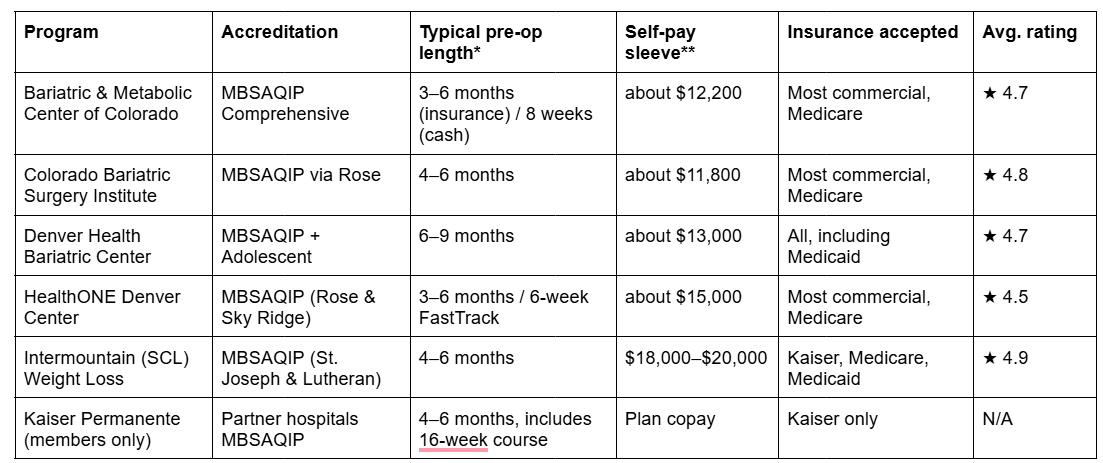
*Insurance timelines depend on supervised-diet requirements.
**Prices current to early 2026; always request a written quote.
Key takeaways appear quickly: Denver Health leads on cost and Medicaid access, HealthONE on speed, and SCL on personal support. Use this grid as your guide, then explore each narrative section to find the culture that fits you.
Ready to choose your path?
Denver offers a rare, exciting problem: too many excellent bariatric programs. The “best” one depends on your personal wish list.
Start by ranking your non-negotiables. If cost tops the list and you have Medicaid, Denver Health is hard to beat. If speed matters most, HealthONE’s FastTrack wins the calendar race. Want boutique support? SCL’s navigators shine. Crave robotic precision? CBSI delivers. Carry a Kaiser card already? The integrated system almost chooses itself.
Next, sign up for at least one free seminar (two if schedules allow). You will sense a center’s culture the moment the presenter starts talking. Take notes, and ask blunt questions about leak rates, cash pricing, and long-term support. Good programs answer without flinching.
Finally, remember surgery is the starting line, not the finish tape. Whichever team you choose, dive into every class, keep those yearly check-ins, and stay active in support groups. Doing so tilts the odds of lasting success sharply in your favor.
You now have the map; the next move is yours. Book a consult, meet the team, and begin the journey toward a lighter, healthier life. We will be cheering from the sidelines.